


Industrial Valves
Pneumatic Actuators
authorized distributor since 1965, offers both from AVCO, Bonomi, and Jomar. Not sure which you need? Contact our valve experts or call 888-825-8800 for sizing help.
Shop Pneumatic Actuators by Category
3 categories


All Pneumatic Actuators
103 products






About Pneumatic Actuators
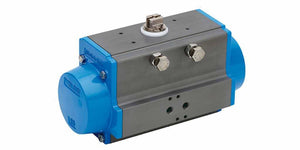
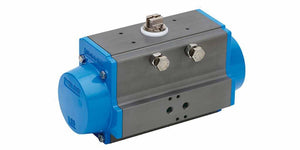
Pneumatic actuators use compressed air to transmit power in order to control a valve. And there are several benefits to them. Pneumatic actuators themselves do not require electrical power to generate motion, making them well-suited for hazardous locations where minimizing ignition sources is important. Any associated electrical accessories, however, must still be properly rated for the environment.
Spring-return pneumatic actuators provide a fail-safe operating mode by automatically driving the valve to its predetermined position if instrument air is lost. Pneumatic actuators generally provide faster operating speeds than electric actuators, particularly for quarter-turn isolation valves. Because compressed air is elastic, pneumatic actuators naturally absorb shock loads, reducing the likelihood of mechanical damage if a valve encounters excessive resistance. Finally, pneumatic actuators have a relatively simple mechanical design with few wear-prone components, making them durable and easy to maintain.

Types of Power Action (Fail-Safe)
One way to categorize pneumatic actuators is by their fail-safe state. For example, double-acting actuators typically remain in their last position following a loss of air pressure unless external forces move the valve. This works extremely well for applications where a sudden valve movement could cause a surge. In single-acting pneumatic actuators, air moves the valve in one direction, compressing the spring, and when the air is lost, the actuator returns to its home position. Its most common use case is safety, where the valve must remain either open or closed in the event of failure.
Types of Valve Motion
For a pneumatic valve actuator to be useful, it needs to match the valve stem's movement. For example, if the motion is a straight-line push/pull, it would be a linear actuator. These actuators are typically found with globe, diaphragm, and gate valves.
On the other hand, a rotary-motion valve stem will need a rotary-motion actuator. This type of actuator provides circular motion, typically a quarter turn (i.e., 90°) to open or close. These actuators work with plug, ball, and butterfly valves.

Internal Mechanisms
Another way to categorize pneumatic actuators is by how their internal mechanism converts air pressure into force. There are four common types:
-
Piston actuators: In this design, a piston moves inside a cylinder; these are well-suited for high-thrust or high-torque applications. An example of this type of pneumatic actuator would be the AVCO ACT-PN-CDA125.
-
Diaphragm actuators: This approach uses air acting against a flexible rubber diaphragm to press against a spring; these are best adapted to throttling and precision control applications and are also very sensitive and reliable. These are most commonly used with globe control valves.
-
Rack and pinion actuators: These are specific to rotary valves and use a gearing system to turn the valve. They are compact, have high torque for their size, and work best for ball and butterfly valves that need on-off control. An example of a rack and pinion actuator would be the Bonomi DA 140.
- Scotch yoke actuators: This design uses a sliding pin and rotating arm to transform pneumatic pressure into rotary motion; this type is well-adapted to large, heavy-duty valves that need a large breakaway force to open. Their torque output is highest at the beginning and end of the stroke, matching the torque requirements of many ball and butterfly valves.

Choosing the Right Pneumatic Valve Actuator for Your Application
Here are a few things to keep in mind when choosing a pneumatic valve actuator. This certainly isn’t an exhaustive guide, but it serves as a good starting point.
| Factor | Requirement / Condition | Recommended Actuator Type |
|---|---|---|
| Valve Stem Motion | Linear (Up/Down) movement (Globe, Gate) | Diaphragm or Piston (Linear) |
| Rotary (90°) movement (Ball, Butterfly) | Rack & Pinion or Scotch Yoke | |
| Safety Protocol | Must close/open on power/air loss | Spring Return (Single Acting) |
| Must stay in last position on air loss | Double Acting | |
| Control Precision | Precision throttling / Modulating control | Diaphragm with a Positioner |
| Simple Open/Close (Isolation) | Piston or Rack & Pinion | |
| Available Air Pressure | Limited available air pressure | Diaphragm (Large surface area) |
| High plant air pressure (> 80 psi) | Piston (Handles higher pressures) | |
| Torque Profile | Constant torque throughout the stroke | Rack & Pinion |
| High "Breakaway" torque (Start/End of stroke) | Scotch Yoke | |
| Space Constraints | Limited envelope / Compact piping | Rack & Pinion |
| Force Requirement | Heavy-duty / High thrust | Piston or Large Scotch Yoke |
Not sure which actuator fits your valve? Send us the valve model and we will confirm sizing and pricing.
Request a Quote
Key Specifications for Pneumatic Actuators
Here are three key specifications you need to have on hand when selecting a pneumatic actuator:
-
Torque Output (In-Lbs or Nm): this value must exceed the valve's breakaway torque by a safety margin (e.g., 25% to 50% depending on service)
-
Supply Pressure: this value is usually rated around a baseline of 40 to 120 PSI of clean, dry instrument air.
- Mounting Pattern: standard ISO 5211 pad configurations ensure easy pairing with your existing valve inventory
Additional Considerations for Pneumatic Actuators
What follows are a few other considerations to keep in mind when specifying your pneumatic valve actuator.
Torque
First, there is torque. Don’t size your actuator for the exact operating torque requirements of the valve. Scale buildup, fluid viscosity, and seat-stick (which happens when valves stay closed for extended periods of time) will also impact the amount of torque needed to control the valve. The standard practice is to apply a safety factor of 20-50% above the valve manufacturer’s torque rating.
Air Supply Quality
Next, we have the quality of the air supply. If the air contains water or contaminants (i.e., dirty air), the particulates can damage the O-rings in both piston and rack and pinion pneumatic actuators. Most modern pneumatic actuators are designed for clean, dry instrument air. While some older designs benefit from lubricated air, introducing oil into systems designed for oil-free service can actually shorten seal life.
Positioners
If your application requires the valve to be 50% open for regulating temperature or pressure, the actuator by itself is not enough. You also need to specify a Pneumatic or Electro-Pneumatic Positioner. These positioners are used to compare the actual valve position to the input signal and then adjust the air pressure until the valve reaches the required open percentage.
Your Partner for Pneumatic Actuators
ValveMan wants to be your partner for pneumatic actuators. We can walk you through the specifications and help you find the ideal solution for your design! Contact us today for help finding the actuator you need!