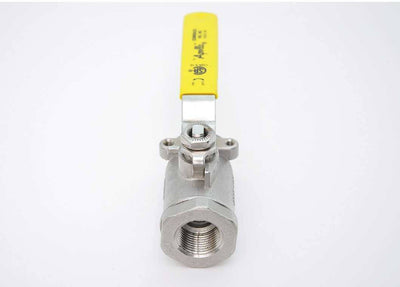


Whether closing off flow to a sink’s supply lines in a home plumbing application, isolating a leg of pipe to service a device in a refinery, or directing the flow of clean steam for sterilization in a pharmaceutical process, the ball valve proves a ubiquitous institution across both domestic and industrial landscapes.
Introduction to Ball Valves
The typical design of a ball valve incorporates a rotating ball with a hollowed-out cylindrical path to create a quarter-turn device that allows process media to flow from upstream to downstream when sitting in the open position but that completely seals the ports on the upstream and downstream sides of the valve when one rotates the ball ninety degrees into the closed position. However, this standard design of a ball valve would not necessarily include a vented ball.
While the applications for employing a generic ball valve may prove seemingly limitless and the purpose of incorporating said valve into a piping design often intuitive, the fundamental utility and frequent necessity of specifically selecting a vented ball valve remain worthy of the particular investigation.
The Premise of the Vented Ball Valve
Having a vented ball means that the ball itself includes a specially drilled orifice bored into a portion of the spherical sealing element. Generally speaking, the purpose of a specifically vented ball in a ball valve remains the creation of a flow path that will allow the trapped service medium a means of egress from the isolated cavity created inside the valve when the ball rotates into the closed position.
Having the means to evacuate this space inside the ball does not prove a necessity in all applications, yet there remain certain instances where having this vent becomes essential.

Risks of Thermal Expansion Owing to Rising Temperatures
Most typically, one finds a vented ball valve employed on services where thermal expansion of the subject medium represents a critical concern, such as in cryogenic applications, refrigeration systems, or processes involving substances like liquid nitrogen or liquid oxygen.
In these cases, the vent is positioned on the upstream side of the valve. In the absence of such a vent, the process medium can become trapped inside the ball when the valve rests in the closed orientation. Rising ambient temperatures surrounding the valve can then lead to the aforementioned thermal expansion of the process gas or fluid, creating internal pressure that can potentially damage the valve or even cause it to explode.
In the presence of a vented ball, the process medium will not become trapped within the cavity of the ball and any thermal expansion owing to rising temperatures will only lead to a normalization of pressures with the medium on the upstream side of the valve. Allowing the service medium to equalize on the upstream side of the ball valve has the added benefit of conserving the medium.
As a means of explanation, consider the following scenario.
A technician rotates a gas ball valve into the closed position in order to isolate a pressure gauge requiring service or replacement. Depending upon the idiosyncrasies of the application, the environment, and the specific gas involved, the technician will likely address the remaining service medium trapped between the closed valve and the gauge pending service by bleeding off the excess, purging the line, or allowing the medium to simply evacuate to the atmosphere after removal of the gauge. Since the gas ball valve in question vents the trapped medium inside the ball to the upstream side, this volume of the gas does not become lost when the technician purges the downstream line.

Risks of Thermal Expansion Owing to Decreasing Temperatures
While rising temperatures generally underlie the perils involved in thermal expansion, dropping temperatures can also present a hazard with certain fluids, most notably, but rather commonly, with water. Most fluid substances tend to become denser in volume as they freeze during the phase shift from their liquid state to their solid-state. However, certain substances counter-intuitively expand as they enter the solid state, given the structure of the crystalline lattice formed as they freeze.
Water remains one such liquid that becomes less dense when frozen, hence the reason why the cubes float in ice water and why a homeowner in the Northern states must winterize their hose bibs in the autumn so their pipes do not burst in the seasonally dropping temperatures. Vented ball valves can account for this thermal expansion as well.
However, equalizing pressure between the cavity of the ball and the upstream line may not prove sufficient to avoid damage. At times, entirely evacuating the service medium from the cavity proves necessary.
Some vented designs account for this contingency by including a purge port on the side of the valve with access to the cavity of the ball when the valve rests in the closed position. This venting port remains plugged during normal service but can open to drain the contents of the said cavity when necessary.
Venting on Air Service and Pneumatic Safety
In the scenarios previously addressed, allowing the trapped process fluid or gas to freely escape from the ball valve to the atmosphere would represent an undesirable result. However, in other situations, such as brass or stainless ball valve used on air service, venting the trapped media to the atmosphere can serve as an ideal solution.
In such cases, the design of such a brass or stainless ball valve may include a vent on its top or its bottom. When the valve rotates into the closed position, the seats completely seal the media on both the upstream and downstream sides of the valve, but the cavity of the ball vents through a special egress path designed into the valve body, allowing the media to escape to the ambient environment. In other applications, a manufacturer may specifically locate a vent of the ball on the downstream side of the ball valve. Often this positioning of a vent will work in conjunction with a vent port that allows trapped media within the ball to exhaust to atmosphere.
This technique often manifests as a safety feature on valves used on the air supply lines feeding pneumatically operated tools or similarly powered devices. When one rotates the valve to the closed position, the positioning of the vent allows media trapped between the downstream device and the closed ball valve to exit via a path back through the ball and subsequently to the atmosphere thus removing any pressure from the downstream pneumatic line and precluding the possibility of accidental activation of the pneumatic device during routine maintenance procedures.
Conclusion
Interested in a ball valve with a vented ball? The experts at ValveMan have the knowledge and experience to help. Shop ValveMan.com today!