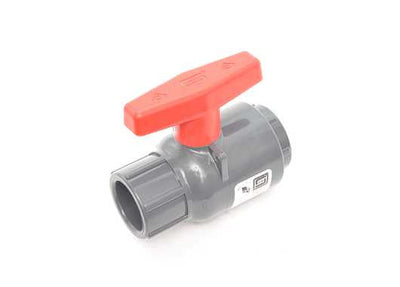


Oftentimes, the question of “Do I really need a control valve?” arises when tasked with engineering an application that involves controlling a process. These control applications may vary in pressure, temperature, flow, conductivity, pH, etc. As such, traditional wisdom would have us pulling out our good old “control valve” books to find a solution. These books typically offer a myriad of different globe-style control valves, usually paired with very accurate diaphragm-type or piston-style actuators.
Typically, these actuators connect to the globe-style valve linearly, thus embodying the traditional model of a true control valve. However, on many occasions, these traditional globe-style valves prove unnecessary as circumstances may permit the implementation of alternative valve solutions.
As different projects require varying degrees of control, we will cover a few simple examples that offer cost-effective solutions for a range of needs and performances.
A Simple Flow Control Solution
For a rudimentary flow control application, one could simply employ a basic flow meter with a digital readout and a hand-style globe valve for manual operation. This simple but savvy arrangement would entail the installation of the digital flow meter (DFM) downstream of the manually operated globe valve. This setup may seem crude, but it proves reasonably effective in static pressure conditions. However, if the inlet pressures and back pressures on the downstream side of the valve vary greatly, this setup would prove ineffective, and we would respectfully suggest an alternative option.
Secondary Solution
The next tier of flow control would involve the implementation of a flow meter that would transmit a 4-20 mA signal to a programmable logic controller (PLC) or to a distributed control system (DCS). One would program this PLC or DCS for a given flow rate. This PLC or DCS would send a signal to a quarter-turn device such as a V-ported ball valve with a rack & pinion pneumatic actuator and electro-pneumatic positioner. This approach to the issue of control offers a better solution compared to the aforementioned “simple flow control solution” given the fact that it can handle the varying inlet pressures and outlet back pressures.
Please note that these variances in the pressures involved cannot prove too great nor oscillate too fast, as this middle-tier flow control setup will only have a 10 to 15: 1 turndown ratio. (NOTE: turndown ratio, defined as the ratio of maximum capacity to minimum capacity, refers to the width of the operational range of a valve or device.) This middle-tier flow control setup will typically offer a turndown ratio in the range of 30:1 to 100:1, still lower than a true control valve's rangeability but well above a manually operated valve.
The approach described provides an affordable and effective “middle of the road” flow control solution.

True Control and True Flexibility
A true control valve will consist of a globe-style, linear valve with a diaphragm-type actuator (or piston-style actuator) with an electro-pneumatic positioner. Manufacturers offer these globe-style valves in several different trim characterizations, of which linear and equal percentage trims remain the two most popular. Traditionally, one would implement an equal percentage trim characterization when the application requires a high degree of turndown ratio with increased accuracy at the low end of the flow range and involves a wide range of inlet and outlet pressures which the valve will see.
Conversely, one typically installs a linear trim characterization for flow control where the process variables remain relatively constant and where one requires the valve to operate with similar accuracy throughout its operating flow range. This valve will offer the highest degree of flow control, or rangeability, compared to the previously discussed solutions.
This typical flow control loop would consist of a flow meter (available in various types) sending a 4–20mA output signal to a PLC or DCS. The PLC or DCS would in turn send a 4–20mA signal out to the linear, globe-style valve, which would modulate accordingly to maintain precise flow control on the discharge side of the valve. This configuration typically proves the most expensive but the most accurate. This is especially true when subjected to varying inlet pressures and back pressures.
However, like all valves, the capabilities of this setup have their limits, as too wide a range of variables in the process could still challenge even this final arrangement. Yes, this valve may approach a 100:1 turndown ratio; however, it remains limited as to how fast it can respond and react to sudden changes in the process conditions. For this very reason, any respectable valve engineer will ask a variety of questions surrounding the expected performance of a given control valve loop.
Which Control Valve Solution is Best for Your Application?
Taking the needed time to explore the true process conditions that a control valve will experience and evaluating the degree of accuracy necessary for control remain key areas one should investigate in the very beginning of the valve specification process. At ValveMan.com valve store, we often see a control valve specified on a Piping and Instrumentation Drawing and ask, “What degree of control is needed and what are the conditions being fed to the valve?” On many occasions, the aforementioned median control solution, such as an automated V-ball valve or other quarter-turn device, may provide more than enough versatility and precision for the application.