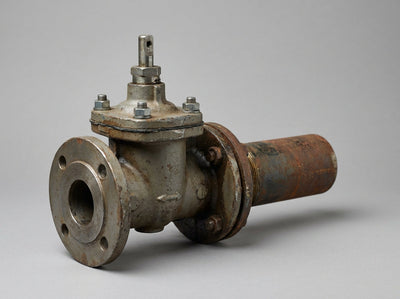


Somewhere in almost every slurry plant there's a wedge gate valve that quit sealing years ago and now gets left open because nobody trusts it. Solids settled into the seat pocket at the bottom of the body, the wedge landed on the pile, and the valve never closed again. The knife gate valve was built for exactly that service. Understand three things about it (what the blade does, what the pressure rating actually is, and which seat to spec) and you'll pick the right one every time.
What a Knife Gate Valve Is and How It Works
A knife gate valve is a gate valve variant with a thin, beveled-edge blade that travels perpendicular to the flow. This knife gate is able to shear through slurries, sediment, and viscous media as it closes. The knife gate works like a guillotine. Where a wedge gate valve would ride up onto packed solids, the knife cuts through them and lands in the seat.
The mechanics are simple. A rising or non-rising stem handwheel threads the blade down into a seat at the bottom of a flat, bonnetless body. The body is a wafer or lug pattern that bolts between standard pipe flanges, so the face-to-face dimension is a fraction of a conventional gate valve's. There is no bonnet cavity for the gate to retract into. The blade exits straight out the top of the body through a packing gland, and that gland is both the design's defining compromise and its main wear point. Remember that for the maintenance section.
The job is specific and the valve is excellent at it: on/off isolation of media that would pack, scale, or jam a wedge-style gate valve.
Knife Gate Valve vs Standard Gate Valve: The Real Differences
Start with the geometry. A standard gate valve closes with a thick cast wedge that drops into a machined pocket. In clean water, steam, or oil, that wedge seals precisely and carries serious pressure. In sludge, pulp stock, or tailings, the pocket fills with solids and the wedge jams as it closes. The knife gate's blade is a thin metal plate, usually 316 stainless steel with a sharpened edge, and it shears whatever is sitting in its path on the way down.
Now the numbers, because this is where the comparison starts making sense. A 16-inch knife gate valve typically weighs under 300 lb. A 16-inch ANSI gate valve runs 1,200 lb or more, and purchase price scales roughly the same way. That weight difference also changes the whole installation and maintenance approach. The knife gate goes in with a chain block and two fitters. The ANSI gate valve needs a crane pick, engineered pipe supports, and a bigger budget, all before you've even opened the crate.
The wedge gate wins one category decisively, and it's pressure handling. An MSS SP-81 knife gate is a 150 psi CWP valve. A cast-steel ANSI Class 150 gate valve carries roughly twice that at ambient temperature, and higher ANSI classes climb from there. If your line runs hot and hard, the ANSI wedge gate valve earns its weight.
One rule applies to both designs; never throttle with gate valves. A partially open gate sits in high-velocity flow that causes vibration, and erodes both the valve seat and body. The blade edge gets chewed, the seat washes out, and the valve fails in a few months of a service that it was never built for. If the process needs flow modulation, buy a control valve, and let the knife gate do isolation.

The Class 150 Flange Trap
Here's the selection error that all too often shows up on real projects. A knife gate valve datasheet says "ANSI B16.5 Class 150 drilling," which is mistakenly read as a Class 150 pressure rating. The drilling callout describes the bolt circle, bolt count, and bolt hole diameter, so the valve mates with standard Class 150 flanges. The pressure rating for an MSS SP-81 knife gate is 150 psi CWP in 2–24 inch sizes.
That distinction matters. A true Class 150 cast-steel gate valve carries nearly double the knife gate valve's working pressure at ambient temperature. Spec a knife gate into a 200 psi line because the piping drawing said "Class 150 flanges" and you've installed a valve at 133% of its rating. When you review a datasheet, find the line that reads "CWP" or "maximum working pressure" and check it against your line conditions.
MSS SP-81 itself is worth knowing. It covers bonnetless, metal-seated knife gate valves from 2 to 24 inches at 150 psi CWP, with the body hydrostatically tested at 1.5 times rated pressure and the gate tested at 1.1 times. The standard also permits metal-seated valves to leak up to 40 cc per inch of valve diameter per minute at 40 psi. Run that math on a 10-inch valve and you get 400 cc per minute, slightly more than a 12-ounce can of soda every sixty seconds, fully within spec. A metal-seated knife gate that weeps at shutoff is performing exactly as the standard says it may. If your process demands zero visible leakage, then you should spec a resilient seat.
Seat Selection: Metal Seat vs Resilient Seat
Seat choice is a major decision on the order form, and temperature settles it more often than not.
An EPDM resilient seat gives you drip-tight shutoff on water, wastewater, and mild slurry, with a hard ceiling of 248°F. The elastomer conforms around fine particles the blade can't shear and closes bubble-tight where a metal seat would weep. Below that temperature, on blunt solids, EPDM is our default recommendation and it should be yours.
A metal seat is the answer when the media runs hotter than EPDM tolerates, scales heavily, or carries sharp, angular solids that slice elastomers. You trade leak-tight sealing for survival: the MSS SP-81 leakage allowance above is the price of a seat that won't be cut to pieces. In scaling or high-temperature service, that trade off is necessary.
The Orbinox Series 20 is a good example of knife gate valves done right, and it's the unit we recommend first for this class of service. It's a uni-directional, lug-type knife gate built to MSS SP-81 and TAPPI TIS 405, with a 316 stainless body, gate, and stem. Sizes run 2 through 36 inches, rated 150 psi CWP in 2–24 inch sizes and 100 psi in 30–36 inch sizes, with ANSI B16.5 Class 150 flange drilling and PTFE-impregnated fiber packing backed by an EPDM O-ring. The same body and blade platform takes either seat: EPDM for drip-tight duty up to 248°F, or a metal seat for the hotter, scaling services an elastomer can't handle.
Here's how you decide which seat to spec. Check temperature against 248°F first. Then assess the solids: percentage, hardness, and edge sharpness. Then ask whether a measurable weep at shutoff is acceptable. Those three answers pick the seat for you.
Uni-Directional vs Bi-Directional: Install It the Right Way
Most knife gate valves, the Orbinox Series 20 included, are uni-directional. This means that the seat holds pressure from one side only, and the body carries a cast or stamped arrow that indicates the seat position. Install the valve backwards and two things happen; the valve leaks at shutoff, and line pressure can push the blade off its seat entirely. In our experience the most common "defective valve" complaint on new knife gate valve installations trace back to orientation, and the fix costs nothing at installation time. Remember that the arrow on a knife gate valve indicates which side the valve seats, it does not indicate the flow direction. Be sure to read the installation manual , verify the valve orientation before the bolts go in, and you'll avoid unnecessary valve orientation problems.
The lug body has its advantages too. Lug connections let you bolt the valve to a single flange for dead-end service, allowing you to unbolt one side of the line without dropping the whole valve out, which a plain wafer body can't do. Be sure to note the dead-end pressure rating of your valve, as its often much less than the valve's working pressure rating. We'd recommend you to spec lug over wafer knife gate valves, every time the budget allows.
Bi-directional knife gate valves are available for lines that see pressure from both sides, and they cost more. Pay for one when the hydraulics genuinely demand it. For a line that always pressurizes from one direction, the uni-directional valve is the better option.

Where Knife Gates Earn Their Keep
Knife gate valves are widely used in pulp and paper, mining, wastewater, chemical, power, steel, and food plants, with abrasive slurry and large-diameter water services doing a lot of volume. The reasons for using knife gate valves differ by industry, and the reasons drive the valve spec.
Slurry and Mining Tailings
Tailings and concentrate lines are among the harshest services a knife gate valve ever sees. Solids settle whenever flow stops, and the beveled blade shears through the settled bed where a wedge would simply park on top of it. Particle hardness decides the seat. Rounded fines in a dilute stream will tolerate EPDM; sharp hard-rock tailings cut elastomers, and metal seats with hardened blades are the right spec. Be realistic about service life, too. Abrasive slurry consumes seats, and in the harshest lines seat life is short enough that replacement belongs on the maintenance schedule as a planned consumable rather than a surprise.
Wastewater
Raw sewage, de-grit chambers, and sludge lines carry rags and stringy solids that wrap around a wedge gate and hold it off its seat. The knife gate cuts through them. EPDM seats deliver the drip-tight shutoff that wastewater isolation requires, and the economics seal the argument at large diameters. Recall the 16-inch comparison: under 300 lb for the knife against 1,200-plus for the wedge. On a 24-inch plant header, the wedge gate's weight and price are prohibitive, and the knife gate is the standard answer for good reason.
Pulp and Paper
This is the design's home industry, which is why TAPPI TIS 405 exists alongside MSS SP-81. Pulp stock at typical line consistency packs a wedge gate's seat pocket within a handful of cycles, while the knife blade slices the mat and seats cleanly beneath it. The 316 stainless steel body and blade also stand up to pulping chemistry that would pit carbon steel in a season.
Actuation, Packing, and Maintenance
A rising-stem handwheel suits valves that cycle occasionally, protects the stem from fluid contact, and the exposed stem gives you position indication from across the gallery. For valves that cycle daily in automated sequences, fit a pneumatic cylinder. For remote isolation on a long tailings or outfall line, an electric actuator earns its keep.
Plan the packing gland as scheduled maintenance, because it will weep eventually and that's normal. The Orbinox Series 20 runs PTFE-impregnated braided fiber packing with an EPDM O-ring. At the first weep, snug the gland bolts down evenly in small increments, alternating side to side so the follower stays square. Cranking one side hard cocks the follower, scores the blade, and multiplies your operating torque. When gland adjustment runs out of travel, repack the valve. Seats are the other consumable, and a knife gate is designed to be rebuilt in line rather than replaced.
Operating discipline matters as much as maintenance. Cycle the valve fully, every time. A blade parked partially open sits in the flow stream and gets eroded, which circles back to the no-throttling rule: this valve lives at 0% or 100% and nowhere in between.
Selection Checklist and Where to Buy
Run these seven checks before you issue the purchase order.
-
Identify the media and solids content.
-
Judge the abrasiveness and edge sharpness of the solids.
-
Check media temperature against the resilient seat ceiling.
-
Confirm line pressure against the valves pressure rating.
-
Establish flow direction, and flag any dead-end service requirements for a lug body.
-
Choose actuation: handwheel, pneumatic, or electric.
-
Verify the face-to-face dimension and weight against your pipe system design.
When the checklist is done, compare seat options and sizes across our knife gate valves collection and match the specs to your requirements. If the service is unusual, say coal slurry at the edge of the EPDM temperature limit, or a tailings line that keeps eating seats, call our team in Exton, PA at 888-825-8800 or contact our valve team and we'll work through the selection with you. We've been specifying valves since 1965, and knife gate valves in ugly service are exactly the kind of problem we like.