


The Best Valves for Gasoline
Gasoline kills valves at the trim level. The bronze or steel body almost always carries pressure margin to spare, while the seat material, the stem seals, the listing on the nameplate, and the coil on the solenoid decide whether an installation stays tight for a decade or weeps fuel within a month. This guide covers ball, check, and solenoid valve selection for gasoline and ethanol blends, decodes UL 842A and API 607, and shows the sizing math most articles skip.
Key Takeaways
- Gasoline valves fail at the trim level, so choose PTFE or RPTFE seats and FKM elastomers as your starting point, and keep EPDM out of the system entirely.
- Ethanol blends attack NBR (Buna-N) seals, so reserve NBR for ethanol-free utility fuel and spec FKM for anything fed from a retail pump.
- A valve's listing must match the fuel, because a UL 842 LP-gas listing doesn't cover gasoline, UL 842A does not cover solenoids, and an API 607 certificate applies only within its qualified valve range.
- Run the Cv math before ordering, since a full-port valve drops about 0.18 psi against about 2.0 psi for a standard-port valve at the same flow, and a low-cracking check protects suction head.
Why Gasoline Punishes the Wrong Valve
Gasoline flashes far below any ambient temperature you'll ever operate in. Every external leak path on a valve, including stem packing, body joint, and pipe threads, vents vapor that ignites the moment it finds a spark. Water service forgives a sweating joint. Fuel service turns that same joint into an ignition hazard with a fire code attached.
The fluid itself makes leaks more likely. Gasoline runs far thinner than water, so it migrates through thread engagement and across seat imperfections that would hold bubble-tight in plumbing service. Seat finish, packing adjustment, and thread sealing all matter more here than in almost any other application a general-purpose valve sees.
Flowing fuel also builds static charge. Quality fuel-rated quarter-turn valves include an anti-static device, typically a spring-loaded contact that keeps ball, stem, and body electrically continuous so charge drains to the grounded pipe instead of arcing across a vapor gap inside the valve.
Then there's ethanol. Blends from E10 through E98 under ASTM D4814 attack elastomers and some soft metals that straight gasoline leaves alone. UL 842A exists largely because of this chemistry. Valves rated for blends up to E85 get evaluated with both CE25a and CE85a test fluids, while lower tiers use CE25a alone (E0–E25) or CE25a and CE40a (E0–E40). The standard's scope covers flammable fluids from -20°F to 125°F. That temperature window frames everything in this article.
Seal and Seat Materials: What Survives Fuel
Read the trim line on the datasheet before you read anything else. It is the pass/fail item for gasoline service.
PTFE and RPTFE Seats
PTFE has the broadest fuel compatibility of any common seat material. It shrugs off gasoline, ethanol blends, and most additives, which is why it's the default seat in quality ball valves. Reinforced PTFE (RPTFE) adds glass or carbon filler for better resistance to cold flow under load. The tradeoff shows up in a fire, where PTFE melts and degrades. That single fact is the entire premise behind fire-safe valve design, which we'll get to under API 607.
FKM (Viton)
FKM is the default elastomer for gasoline, holding up to petroleum oils and fuels from roughly -20°F to 400°F (varies by compound). Spec it for O-rings, stem seals, check-valve poppets, and solenoid seals. Our recommendation after 60+ years of fuel-service spec work is simple: make PTFE seats plus FKM elastomers your starting point for every gasoline valve and force any deviation to justify itself.
NBR (Buna-N): Honest Limits
Buna-N works in straight gasoline at moderate temperatures, and it costs less than FKM. The problem arises with ethanol. NBR degrades faster as blend levels climb, and most pump gasoline in the U.S. carries ethanol. Apply the CE85a logic here: a seal proven only on low-blend fluid is unproven at E85, full stop. NBR is a reasonable economy choice for ethanol-free utility fuel and the wrong choice for anything fed from a retail pump.
EPDM: Keep It Out of Fuel
EPDM has poor resistance to gasoline and hydrocarbons. It swells, softens, and fails. Generic compatibility charts bury this in a footnote, so we'll say it plainly: EPDM has no place anywhere in a gasoline system.
Here's where this bites in practice. Plenty of manufacturers sell the same valve body with a choice of trim, and on the order sheet the EPDM version differs from the FKM version by one character in the part number. In gasoline, that character separates a valve that seals for years from one whose O-rings swell until the stem weeps fuel. Check the trim code on every line item, every time.
| Material | Fuel & Ethanol Compatibility | Typical Valve Role | Key Strengths & Limitations | Spec Verdict |
|---|---|---|---|---|
| PTFE / RPTFE | Straight gasoline, E10–E85 ethanol blends, and most additives | Ball valve seats | Broadest chemical compatibility; glass- or carbon-filled RPTFE resists cold flow under load. Melts in a fire (requires API 607 secondary metal seat for fire-safe service). | Default Seat |
| FKM (Viton) | Straight gasoline, ethanol blends, and petroleum oils (-20°F to 400°F) | O-rings, stem seals, check-valve poppets, solenoid seals | High heat and chemical resistance across pump fuels. Standard baseline elastomer when paired with PTFE seats. | Default Elastomer |
| NBR (Buna-N) | Straight (ethanol-free) gasoline at moderate temperatures | Economy O-rings and soft seals | Lower cost than FKM, but degrades rapidly as ethanol concentration increases; unproven at high blends like E85. | Ethanol-Free Only (Avoid for pump gas) |
| EPDM | Incompatible with gasoline and hydrocarbons | None (water/steam service only) | Swells, softens, and fails on contact with fuel. Often differs from FKM by a single character in the valve part number. | Do Not Use |
Not sure which trim fits your fuel and ethanol level? Talk to a ValveMan engineer at 888-825-8800 — real engineers, not a call center — before you commit the part number to a PO.
Gasoline Compatible Ball Valve: What to Spec
Start with the body. Bronze and brass handle low-pressure fuel transfer well and keep cost down. Carbon steel or 316 stainless makes sense for higher pressures, buried service, or outdoor installations where mechanical abuse is likely. One caution on yellow brass: some alloys give up zinc over time in aggressive media, so if you're running high-ethanol blends, ask the manufacturer for alloy compatibility data instead of assuming.
A gasoline-compatible ball valve needs four features regardless of body metal. It needs a blowout-proof stem, assembled from inside the body so internal pressure can't eject it. It needs an anti-static device. It needs adjustable packing, because stem seals in fuel service deserve a maintenance path other than replacement. And on transfer lines it should be full port.
The port decision is worth running numbers on. Pressure drop through a valve follows ΔP = (Q/Cv)² × SG, and gasoline's specific gravity is about 0.73. Take an illustrative 1" transfer line moving 20 GPM. Through a standard-port valve with a Cv of 12, the drop is (20/12)² × 0.73, or about 2.0 psi. Through a full-port valve with a Cv of 40, the same flow drops roughly 0.18 psi. On a pressurized header that difference is trivial; on a pump suction line it can decide whether the pump cavitates. Pull the actual Cv from the datasheet of the valve you're buying and run this math before you order.
Body pressure rating rarely drives the decision. Fuel transfer runs at modest pressure, and a quality bronze ball valve carries far more pressure capability than the line will ever demand. The trim and the listing set the real limit.
On listings, consider the Apollo 80-100 Series bronze FNPT ball valve, a two-piece bronze body with FNPT ends listed for LP-gas service. It's a good example of a UL 842-listed valve, and it's also a good example of why you read listing scope carefully. UL 842 (i.e., Valves for Flammable Fluids) covers manually operated LP-gas valves. Gasoline and ethanol blends fall under UL 842A, a separate standard with its own test fluids. An LP-gas listing covers LP-gas; before you carry any valve across to a different fuel, confirm the listing was evaluated for that fuel. We walked through the same listing-scope question for a different fuel in our guide to selecting the best Apollo ball valve for natural gas use. If you'd rather have someone check the port math and the listing against your line, call 888-825-8800 and we'll run it with you.
Fuel Line Check Valve and Anti-Siphon Duty
A fuel line check valve earns its place three ways. It blocks backflow when the pump stops. It holds prime on suction lines so the pump doesn't run dry at every restart. And at the tank, it provides anti-siphon protection.
That last job deserves a proper definition, because the knowledge mostly lives in boat forums. An anti-siphon valve is a spring-loaded check mounted at the tank outlet. If a fuel line breaks below fuel level, gravity will happily siphon the tank out through the break; the spring holds the check closed against that gravity head so the pump can pull fuel through it, but a broken line can't. Marine installations commonly require one, and any gravity-exposed tank deserves the same thinking.
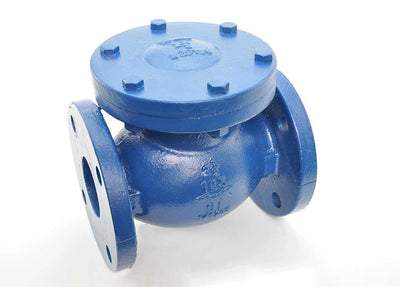
For gasoline, spec a spring-loaded check over a swing check. Spring checks seat positively in any orientation and suit thin, low-viscosity fuel. Swing checks depend on gravity to close and tend to chatter on pulsing pump flow. A compact spring-loaded design from our in-line check valve range is the right pattern for most fuel lines.
Cracking pressure costs you suction head, so do the arithmetic. Converting pressure to head uses feet = psi × 2.31 ÷ SG. In gasoline at 0.73 SG, a 3 psi cracking pressure costs about 9.5 feet of equivalent suction head. A 0.5 psi check costs about 1.6 feet. For a small transfer pump with limited suction lift, that 8-foot difference is the whole budget. Keep cracking pressure low everywhere in the suction path. Use a low-cracking check near the pump, and if you add a tank-mounted anti-siphon valve, add its cracking pressure to the head budget above.
Trim rules carry over unchanged: FKM or PTFE on the poppet seal, and EPDM stays out of the system. Metal-seated checks trade bubble-tight shutoff for fire survivability, which matters because check valves have their own fire standard. API 6FA (which absorbed API 6FD in 2020) covers fire testing of check valves.
Solenoid Valve for Gasoline: Coil and Seal Rules
The wetted-parts spec for a solenoid valve for gasoline is settled: brass body, FKM seals, normally closed so a power loss shuts off fuel instead of dumping it. The coil is where specs go wrong, in two ways nobody writes about. UL 842A does not cover electrically operated valves, so a solenoid cannot carry a UL 842A listing. Check the solenoid's own flammable-liquid and hazardous-location approvals.
First, duty cycle. Some coils are rated for intermittent duty only and can burn out if left energized continuously. A valve that holds open all shift long needs a continuous-duty-rated coil, and that rating must appear on the datasheet, since a burned coil on a fuel line is both a process failure and a heat source sitting in a vapor zone.
Second, area classification. Gasoline vapor zones may be classified Class I Division 1 or Division 2, and a general-purpose coil in a classified area is an ignition source. If the valve lives near a tank vent, a dispensing point, or a sump, confirm the classification and spec a hazardous-location-rated coil assembly to match. If you're unsure how your area is classified, call us at 888-825-8800 before you buy the valve — real engineers will walk the classification with you.
Operating principle matters too. Pilot-operated solenoids need a minimum pressure differential to open, and gravity-fed fuel lines often can't supply it. Direct-acting valves work from 0 psi, which makes them our default recommendation for fuel transfer and day-tank service.
Size the orifice with the same Cv formula, rearranged: Cv = Q × √(SG ÷ ΔP). Suppose you need 8 GPM of gasoline with 5 psi of allowable drop. That works out to 8 × √(0.73 ÷ 5), or a required Cv of about 3.1, so you'd spec a valve with a published Cv at or above that figure. For the broader question of when a solenoid beats an actuated ball valve, we've compared actuated ball valves versus solenoid valves for fluid control in detail.
Certifications Decoded: UL 842, UL 842A, and API 607
Standards questions sink more fuel-valve specs than materials questions do. Three distinctions cover most of the confusion.
UL 842 vs UL 842A
UL 842 is titled Valves for Flammable Fluids and covers manually operated valves for flammable and combustible liquids, including manual LP-gas valves. UL 842A is the gasoline standard, used alongside UL 842: it covers valves for gasoline and gasoline/ethanol blends up to E85 across a -20°F to 125°F scope, and Edition 3, dated July 2026, extends that scope to E98. It excludes electrically operated valves. Valves rated to E85 under UL 842A get evaluated with both CE25a and CE85a test fluids, which is the standard's built-in answer to ethanol attack. For gasoline service, ask for the UL 842A evaluation by name and read the blend level it covers. Lower blend tiers use CE25a and CE40a.
API 607 and What a Certificate Actually Proves
API 607 is a fire type-test for soft-seated quarter-turn valves. It confirms the valve limits leakage during and after fire exposure, which works because an API 607 fire-safe ball valve carries a secondary metal-to-metal seat that engages once the soft PTFE seat burns away. The valve limits leakage while it's on fire, within the test's allowable limits. Our fire-safe ball valves are built around exactly this architecture.
An API 607 certificate covers only the valve designs, sizes, and pressure classes within its qualified range. A passing 2" Class 150 test doesn't automatically cover a 6" version of the same model. Ask the supplier for the actual certificate and check its qualified size and pressure range against the exact valve on your purchase order.
Matching the Fire Standard to the Valve Type
Match the standard to the valve type on your spec sheet, because a fire certificate from the wrong standard tells you nothing about the valve in front of you.
Fire-safe construction is mandatory where code says so and smart in several places where it doesn't. Motor fuel dispensing facilities fall under NFPA 30A, bulk transfer terminals face pool-fire exposure by definition, and any valve a burning spill can reach should keep sealing after its soft seats are gone. We supply this class of service across the oil and gas industry, where fire-safe shutoff on fuel-handling lines is routine practice rather than an upgrade.
Spec Checklist and Getting It Right the First Time
The workflow compresses to one sequence. Identify the fluid and its ethanol level, then pick seat and seal materials that survive it, with PTFE and FKM as the default. Choose the body metal for pressure and environment, confirm the listing matches the fuel (UL 842A for manual gasoline valves, fire-safe certification where code or exposure demands it), and separate hazardous-location approval for solenoids. Also size the end connection and Cv with real datasheet numbers, and finish with actuation, including coil duty cycle and area classification.
Installation deserves the same discipline. Use PTFE tape or a fuel-rated thread paste, never generic pipe dope with unknown fillers that gasoline will dissolve. Maintain grounding and bonding continuity across the valve. Keep shutoffs accessible, because a fuel valve you can't reach in an emergency might as well not exist.
ValveMan Has Gasoline Valves
| Valve Application | Recommended Model | Body & Trim | Key Standards & Ratings | Specifier Note |
|---|---|---|---|---|
| Manual Fuel Shutoff |
Apollo 80-100 Series (or full-port Apollo 82A-140 Series)
|
Bronze body, RPTFE seats, FKM stem seals, blowout-proof stem | UL-listed for flammable liquids / LP-gas | Confirm UL 842A blend coverage (E10–E85) on the sub-model; pick full port to minimize pump suction ΔP. |
| Fire-Safe Quarter-Turn Shutoff |
Apollo 88A-200 Series (or 316SS Apollo 87A-100 Series)
|
Carbon steel or 316 stainless steel, RPTFE primary seat + metal secondary seat | API 607 fire-safe certified, anti-static device | Verify the API 607 certificate covers the exact valve size on your PO (required for NFPA 30A & bulk transfer). |
| Spring-Loaded Line Check |
Apollo 61-100 Series (or 316SS Apollo 62-101-01)
|
Bronze or 316 stainless steel, spring-actuated RPTFE ball check | 0.5 psi cracking pressure | Mounts in any orientation without chatter; low 0.5 psi spring preserves ~8 ft of suction head over a 3 psi check. |
| Automated / Hazardous-Area Shutoff |
ASCO EF8210G Series (with  |
Brass body, FKM (Viton) seals, Normally Closed (NC) | NEMA 7 explosion-proof coil (Class I, Div 1 & 2), continuous duty | Specify the FKM (Viton) trim code rather than standard NBR, and match coil rating to your vapor zone classification. |


Get the Spec Right Before the PO Goes Out
We've been specifying valves for fuel service since 1965, and our team in Exton, PA has seen most of the ways a gasoline spec goes sideways before the first fitting is tightened. Send us your application through our contact page or call 888-825-8800, and real engineers — not a call center — will review the fluid, the trim, and the listings with you before you commit to a purchase order.