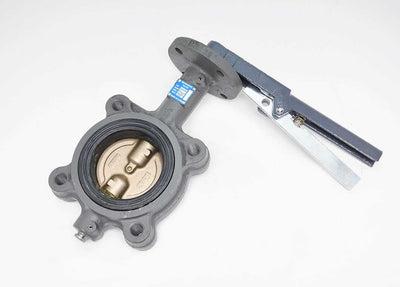


Take the disc, stem, and seat out of a lug butterfly valve and a wafer butterfly valve of the same size and class, and you'll be holding identical parts. The whole decision comes down to the body and how it mates to your flanges. That one difference decides whether you can pull a pump without draining the system, what the valve weighs, and what you pay at every position on the line. Get it right, and nobody ever thinks about the valve again. Get it wrong, and a one-hour maintenance job turns into a full shutdown.
One Valve, Two Bodies: How Butterfly Valves Work Before the Lug/Wafer Split
Butterfly valves are quarter-turn valves. The disc rotates 90 degrees on the stem: parallel to flow when open, perpendicular and pressed into a resilient seat when closed. A short face-to-face dimension and simple trim make them the cheapest way to shut off a line at 4 inches and above, which is why they dominate water, HVAC, and general industrial service.
Several competitor guides call lug the "high-pressure" style and wafer the "low-pressure" style. That claim is wrong. Under API 609, Category A covers manufacturer-rated CWP concentric valves from NPS 2 through 60 with ASME Class 125/150 bolt patterns, and Category B covers Class 150 and 300 valves across the same size range. Both body styles appear in both categories. Pressure class comes from the body casting and trim. The lug/wafer choice is about mounting, isolation, and maintenance access.
One housekeeping item before we go further. A surprising number of buyers search for "wafter butterfly valves." The word is wafer, as in a thin body clamped between two flanges like a wafer, and that's the spelling we'll use from here.
Lug Butterfly Valves: Bolted to Each Flange Independently

A lug butterfly valve has threaded inserts, the lugs, cast around the body perimeter. Cap screws pass through each flange and thread directly into those lugs. You install two independent sets of screws, one per flange, and each side of the valve carries its own bolted joint.
That independence is the entire point. Unbolt the downstream piping and the valve stays anchored to the upstream flange, still holding line pressure against its seat. You can pull a pump, drop a strainer basket, or remove a section of pipe while the rest of the system keeps running.
The costs of that capability are real. A lug body carries more metal, takes twice the fastener count, and prices higher than a wafer of the same size.
One thing lug spec sheets rarely spell out: a lug valve used as an end-of-line isolation point has a lower dead-end pressure rating than the same valve mid-line, because only one flange holds the load. Check the manufacturer's dead-end rating before you count on it as a shutoff.
Sizing a lug body for dead-end service or matching lugs to your flange class? Call a ValveMan engineer at 888-825-8800. Real engineers, not a call center.
Wafer Butterfly Valves: Clamped Between the Flanges
A wafer body has no lugs. It sits sandwiched between two flanges, centered by the bolts that run flange-to-flange, and the long studs carry the whole joint through the valve. Fewer parts, less metal, lighter weight, lower price.
The tradeoff shows up the day you need to open a line. Loosen the studs on one side, and the joint goes slack on both sides, because the same bolts hold both flanges. There's no independent anchor. Pull the downstream pipe and the upstream side unloads too, so a wafer valve can't hold back line pressure with the far flange removed. Use wafer bodies where the valve stays put and both sides of the pipe stay connected during service.
Weight, Cost, and Fastener Count: The Practical Differences

Put a 6-inch Class 150 pair side by side and the pattern is consistent. The wafer is lighter and cheaper, with one set of studs running the full length. The lug carries more casting weight, threads two independent bolt sets, and costs more up front.
That up-front price gap isn't the whole cost story. If a wafer valve sits at a point where you'll eventually isolate one side for maintenance, the "savings" evaporates the first time you drain and refill the system to work around it. Buy the lug where isolation matters. Buy the wafer where it doesn't.
Weighing first cost against downtime cost on a specific line? That's a five-minute phone call. Reach us at 888-825-8800 or send the details here.
How to Choose: Match the Body to the Job
Pick lug when the valve is an isolation point — end of a header, at a pump, ahead of equipment you'll service while the rest of the system runs. Pick lug at any dead-end or end-of-line position, subject to the dead-end rating above. Pick wafer for straight in-line duty where you'll never break just one side: pump discharge into a manifold that gets shut down as a unit, HVAC chilled-water runs, general on/off service.
Class, seat material, and disc/stem metallurgy come from the service, not the body style. Set the pressure/temperature and the media first, then choose lug or wafer for how the valve mounts and how you'll maintain it.
Talk It Through Before You Buy

Get the body style wrong and you pay for it in downtime, not on the invoice. Our engineers in Exton, PA have been sizing valves to real service conditions since 1965 — call 888-825-8800 with your class, size, media, and maintenance plan, or start here and we'll work it out with you.