

Acetone rates D or unsatisfactory on most charts against both Buna-N and Viton at room temperature. Those two elastomers sit inside nearly every commodity ball valve, solenoid valve, and globe valve on the market. That single fact explains most acetone valve failures we've helped diagnose over 60 years, and it sets the shape of this guide. The metal side of the spec is simple. Acetone is generally compatible with 304 and 316 stainless, carbon steel, and even aluminum. Every real decision lives in the soft goods: seats, stem packing, body seals, and O-rings. Get those right and almost any decent stainless ball valve will run acetone for years.
⚙️ Key Takeaways
- Standard valve elastomers like Buna-N and Viton degrade quickly when exposed to acetone, leading to swelling, seal failure, and valve leaks.
- Ideal seal materials for acetone include PTFE (best for seats and packing), EPDM (suitable for O-rings on single-solvent lines), and high-cost FFKM for high-temperature applications.
- Metal valve bodies made of 316 stainless steel are recommended over carbon steel or plastic, though every soft good in the wetted path must be verified to prevent failure.
- Because acetone is a Class IB flammable liquid, valves on acetone lines should incorporate fire-safe certifications (API 607), anti-static stem designs, and explosion-proof actuation.
Why Acetone Destroys Standard Valve Seals
Acetone (dimethyl ketone, CAS 67-64-1) is a small, aggressive polar solvent, and ketones are a known blind spot for the elastomers that dominate valve catalogs. The failure sequence is predictable. The ketone penetrates the polymer matrix, the seal absorbs solvent and swells, and the material softens. On a ball valve, stem torque climbs first as the swollen seats grip the ball. Then the seat extrudes under line pressure and the valve starts to weep at the stem or past the seat. By the time an operator notices the handle getting stiff, the soft goods are already gone.
The Viton trap deserves a direct callout because it catches experienced buyers. Standard FKM handles oils, acids, and most hydrocarbons so well that people treat it as a universal chemical-service seal. Ketones are its documented weakness. A Viton-sealed valve in acetone will swell and fail, and the published compatibility rating is a flat D at room temperature, the same grade as cheap Buna-N. Paying the Viton upcharge for acetone service buys you nothing.
MEK behaves the same way. If your line carries methyl ethyl ketone instead of acetone, or a blend of the two, everything in this guide applies unchanged.
Seal Materials That Survive Acetone
PTFE is the default answer, and we'd call it the only answer for seats and packing. It rates A in acetone, and its compatibility problems across the board are limited to fluorine and molten alkali metals as well as fluorinating agents such as chlorine trifluoride. That breadth matters in a plant. Process streams change, lines get repurposed, and a PTFE-sealed valve keeps working when the acetone line starts seeing toluene next year. The PTFE family covers virgin PTFE, glass-reinforced RPTFE, filled grades, and TFM modified PTFE, and we compare those grades with numbers further down.
EPDM also rates A in acetone, which surprises people who know it mainly from water service. It works for body O-rings and diaphragms where you want elastomer resilience instead of PTFE's cold flow. One hard warning comes with it. EPDM fails in oils and hydrocarbons, so it's the wrong call on any line that might later carry mineral spirits, fuels, or lube oil carryover. In a single-solvent acetone plant, EPDM O-rings are fine. In a mixed-solvent plant, they're a trap waiting for a stream change.
FFKM perfluoroelastomers, sold as Kalrez, Chemraz, and Markez, handle acetone at temperatures to about 500–600°F depending on grade. The cost is very high, so reserve FFKM for hot service or for sealing positions where only a true elastomer works and EPDM's temperature or mixed-media limits rule it out.
Quick Compatibility Table
Neoprene and silicone also show up as seal options on commodity solenoid valves. We don't spec either one for ketone service, and if a vendor offers them on an acetone application, have them show you a current chart rating before you accept.
How to Read a Compatibility Chart
Every rating in that table assumes room temperature and nearly pure acetone. Heat accelerates solvent attack, so a material that holds at 70°F can fail at 200°F. Mixtures shift the answer too, sometimes in both directions, and concentration matters less than buyers hope. A chart is a screening tool. It tells you what to reject immediately, Buna-N and Viton here, and what to carry forward into a review of your actual temperature, pressure, and blend.

Body and Trim: Why 316 Stainless Is the Default
Both 304 and 316 stainless rate A with acetone at room temperature, so either grade survives the media. We still spec 316/316L, cast as ASTM A351 CF8M, as the standard body and trim material for solvent lines. The price difference over 304 is small at valve scale, and 316 keeps its margin if the stream picks up chlorides or shifts to a harsher solvent later. For acetone transfer equipment specifically, a stainless body with stainless trim and PTFE sealing elements is the published recommended combination, and it matches what we've specified for decades.
Acetone doesn't corrode carbon steel or aluminum either, which raises an obvious question about cheap brass and carbon-steel valves. The bodies survive. The valves still fail, because commodity brass and carbon-steel valves ship almost universally with Buna-N or Viton soft goods. You'd have to re-seal them to make them acetone-safe, and at that point a stainless valve with PTFE seats costs less than the labor.
Plastic bodies are out entirely. Acetone attacks and can dissolve PVC and many other thermoplastics, so a PVC or CPVC ball valve has no place on a ketone line regardless of what seal material it carries. The body itself is the wetted part that fails.
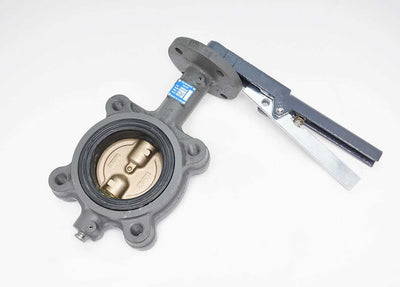
The Workhorse: 316SS Ball Valve with PTFE Seats
For shutoff and isolation, which covers most acetone duty, the answer is a 316 stainless floating ball valve with PTFE or TFM seats and PTFE stem packing. The soft-seated quarter-turn design gives bubble-tight shutoff, which matters more with a Class IB flammable liquid than with water. A metal-seated globe valve with a Class IV or lower leakage rating is an annoyance on a chilled water line and a vapor hazard on an acetone line. If you're comparing specific models and manufacturers, start with our rundown of the top ten ball valves by model and manufacturer.
Choose the body style by how you plan to maintain it. A 2-piece valve costs less and does the job on lines you can drain and pull. A 3-piece valve lets you swing the center section out and replace seats in line, and on solvent service, where seats are the wear item, that pays for itself at the first rebuild. Our valve maintenance best practice guide covers the rebuild workflow in detail.
Globe valves earn their place where you need to throttle acetone flow, feeding a process at a controlled rate, for example. Spec stainless trim and PTFE packing, and size with the Cv difference in mind. A full-port ball valve passes far more flow than a same-size globe valve, so a globe valve selected by pipe size alone can starve a transfer pump. Run the Cv calculation against your required flow and allowable pressure drop before you pick the line size.
Solenoid valves handle automated dosing and small-bore on-off duty. Order the stainless body and specify PTFE or EPDM seals explicitly, because the stock seal on most solenoid valves is NBR or FKM and both fail in acetone. The coil needs an area-classification rating too, which we cover below. For help deciding between a solenoid and a small actuated ball valve on solvent duty, we've written a full comparison of using an actuated ball valve or a solenoid valve for fluid control.
On end connections, NPT threads are fine for small-bore transfer lines. Process lines should go ASME B16.5 Class 150 flanged or tri-clamp where sanitary-style breakdown helps. Where fugitive vapor emissions are a concern, socket-weld connections remove the threaded joints from the vapor path.
Seat Grades Compared: Virgin PTFE vs RPTFE vs Filled PTFE vs TFM
All four grades rate A in acetone, so this choice is about temperature, pressure, and cycling rather than chemistry.
Virgin PTFE is the baseline and the right pick for ambient transfer duty. Its weaknesses are cold flow under sustained load and falling pressure capacity as temperature climbs. RPTFE adds glass reinforcement, which raises pressure capacity and cuts cold flow, and it's the sensible default upgrade for valves that cycle often. A 50/50 stainless-filled PTFE seat extends service to about 550°F and to higher pressures than virgin PTFE, with a real tradeoff. The filled seat runs higher friction, which raises stem torque, and that torque figure feeds directly into actuator sizing. An actuator sized for virgin PTFE seats can stall on filled seats in the same valve.
TFM modified PTFE is the premium pick. It offers lower permeability and reduced cold flow than standard PTFE and carries a service range of roughly -50°F to 500°F, per the seat manufacturer. For thermal cycling, vacuum service, or any line where permeation of solvent vapor through the seat matters, TFM is worth the modest premium.
A worked example makes the choice concrete. Take a 1-inch 316SS ball valve moving acetone from a tote to a mix tank at ambient temperature and under 150 psi. Virgin PTFE seats handle that duty with margin, and there's no reason to pay for more. Now put the same valve on a solvent recovery loop running near 300°F. Virgin PTFE's pressure rating has derated steeply by that point, while TFM, rated to 500°F, and stainless-filled PTFE, rated to about 550°F, both keep usable margin. Same valve body, same media, different seat spec. The rule that governs here is simple and widely ignored. The seat pressure-temperature curve limits the valve, never the body rating stamped on the casting. Read the manufacturer's seat P/T chart before you buy.
Acetone Is a Class IB Flammable Liquid, So Spec for Fire
Compatibility charts stop at chemistry, and for acetone that's half the job. Acetone is an OSHA/NFPA Class IB flammable liquid with a about -20°C (-4°F), closed cup and an autoignition temperature of 465°C (869°F). It forms flammable vapor-air mixtures at roughly 2.5 to 13 percent by volume, and the vapors are heavier than air, so they sink and travel along grade until they find an ignition source. A leaking valve in a pipe trench can feed a vapor cloud a long way from the leak.
Dilution offers less protection than people assume. A 10 percent acetone-in-water solution still has a flash point around 80°F, so a "mostly water" rinse line keeps its flammable character on a warm day. Spec the diluted line like the concentrated one.
Three requirements follow from the classification. First, ask for fire-safe certification on soft-seated valves; API 607 is the fire-test standard to cite on the purchase order. The design puts a metal backup seal in place that takes over after a fire burns the PTFE seat away, so the valve still holds instead of dumping fuel into the fire. Second, require anti-static stem design, meaning verified electrical continuity from ball to stem to body. A dry PTFE-on-stainless interface can generate static charge in service, and the continuity path bleeds it to ground. Third, ground and bond the line, the valve, and the receiving vessel during transfer.
Actuation has to match the area classification. In a Class I, Division 1, Group D area, use spring-return fail-closed pneumatic actuators so the valve shuts on air loss, or explosion-proof electric actuators carrying the Division 1 rating. Solenoid coils need the same rating. A general-purpose coil on an acetone dosing valve is an ignition source bolted directly to the hazard.
ValveMan has the Acetone Valves You Need>


Check the Whole Wetted Path, Then Order
Here is the failure mode that catches careful buyers. A valve advertised with PTFE seats can still carry an FKM body O-ring, an FKM stem seal, or elastomer thrust washers, and any one of those fails in acetone exactly as fast as a Viton seat would. Audit every soft good in the wetted path before you sign off.
The spec reads like this. The body and trim are 316 stainless, cast per ASTM A351 CF8M. The seats are PTFE, with the grade matched to your temperature and pressure, and every body seal, stem seal, and thrust washer is PTFE or EPDM. For flammable-service duty, the valve carries API 607 fire-safe certification and an anti-static stem. Call us at 888-825-8800 or reach the team through our contact page to confirm the full wetted-path spec before you order.