

A cooling tower loop runs at pressures any Class 150 valve shrugs off. The water is what kills valves. An open recirculating tower concentrates dissolved solids every hour it runs, scrubs airborne grit into the basin, and carries a steady dose of oxidizing biocide on top. Pick valves for a tower the way you'd pick them for a mild chemical service, because that's what the water becomes.
This guide works through the loop one application point at a time: isolation, pump discharge, blowdown, makeup, chemical dosing, and bypass. Pick the valve type by where it sits. Pick the body, seat, and trim by the chemistry.
Why Cooling Tower Water Eats Valves
Evaporation removes pure water and leaves everything else behind. The ratio of tower-water TDS to makeup-water TDS is called cycles of concentration, and most systems target about 3 to 6, depending on makeup quality and treatment. Calcium, magnesium, chloride, and silica all climb with the cycles, and the U.S. Department of Energy's cooling tower guidance is blunt about the consequence: left uncontrolled, those concentrated solids scale heat-transfer surfaces and corrode metal.
Chloride is the number that should drive your trim selection. A common guideline holds chloride below roughly 300 mg/L in stainless systems and below 150 mg/L in galvanized ones, commonly cited. Run the arithmetic backward.
Practical Cooling Tower Metallurgy Example (Chloride Limits & Cycles):
Cooling towers concentrate dissolved solids as pure water evaporates. Chlorides (Cl⁻) are particularly aggressive, stripping the protective oxide layer from metals and triggering severe localized pitting and stress corrosion cracking (SCC).
Concentration Formula:
Tower Chlorides = Makeup Chlorides × Cycles of Concentration (CoC)
-
Galvanized Steel Limit (~150 mg/L Cl⁻):
At 5 cycles, a makeup water supply with just 30 mg/L Cl⁻ yields 30 × 5 = 150 mg/L in the basin—hitting the maximum threshold before white rust failure and galvanizing stripping accelerate. -
304 Stainless Steel Limit (~300 mg/L Cl⁻):
At 5 cycles, a makeup water supply with 60 mg/L Cl⁻ reaches 60 × 5 = 300 mg/L in the basin—the industry ceiling for 304 SS to prevent severe crevice corrosion and pitting.
Engineering Takeaway: Standard municipal drinking water frequently carries 30–80 mg/L of chlorides due to natural mineral content and water treatment. Unless cycles of concentration are lowered or materials upgraded (e.g., to 316L SS or fiberglass), unadjusted municipal water will rapidly degrade standard cooling tower metallurgy.
We spec 316 stainless trim in tower service as a default and treat 304 as a compromise you make with your water report open in front of you. Keep in mind that 316 tolerates substantially higher chloride than 304, and that crevices and temperature lower the limit
Treatment chemistry adds a second attack. Sodium hypochlorite and bromine-based oxidizing biocides harden and crack Buna-N elastomers over time. EPDM tolerates typical loop residuals at residuals of about 0.5–1 ppm ree halogen, and PTFE handles the concentrated chemical at the feed point itself. Phosphonate and polymer scale inhibitors are milder, but the biocide alone is enough reason to stop specifying Buna seats in tower water.
Then come the solids. A cooling tower is an air washer whether you want one or not. Dust, pollen, and construction grit end up in the basin, and that slurry abrades resilient seats and packs into the dead pockets of the wrong valve designs. Keep that picture in mind for the gate valve discussion below.
Have a water report but not a trim answer? Talk to a ValveMan engineer at 888-825-8800 — real engineers, not a call center, and we've been running this math since 1965.
Isolation and Balancing: Resilient-Seated Butterfly Valves
Butterfly valves are the most commonly used valve type in cooling water systems, and for good reason on large-diameter condenser and tower lines. They cost a fraction of a gate or globe valve per inch of diameter, their short face-to-face saves pipe-rack space, and they come in manual, electric, and pneumatic versions. A resilient-seated butterfly also throttles acceptably for balancing duty, which gate valves never should because of how pooly suited they are for cooling tower applications. Condenser water is one leg of a larger plant, and our HVAC industry page covers how the same selection logic extends to the rest of the mechanical room.
Lug or Wafer
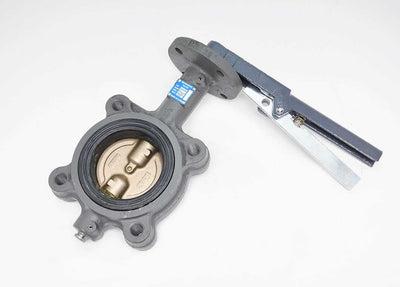
Buy lug-pattern valves anywhere you might need dead-end service. A lug butterfly bolts to each mating flange independently, so you can unbolt a pump, strainer, or tower cell on one side while the other side stays full and pressurized. A wafer valve clamps between flanges and requires draining both sides before you break the joint. Wafer bodies cost less, and they're fine deep in a header where both sides drain together.
 A typical wafer valve that would be appropriate for this type of use would be the SVF Flow Control Streamline SLB Butterfly Valve. It has a A536 ductile iron body with epoxy-coated wetted surfaces. It also has a ASTM A351 CF8M austenitic stainless steel disc, and has an EPDM seat option. They are also available in gear or lever control options.
At every pump and every cell connection, pay for the lugs. You'll collect the premium back the first time you swap a pump seal in July without draining the loop.

One of our best butterfly lug valves is the Bonomi ME541S-00 Series. These butterfly valves have a ductile iron body with a CF8M stainless steel disc that can be upgraded to 316 SS, and the valves are available with EPDM seats. The MEN501 series features a rugged, NEMA 4-rated electric actuator in a powder-coated aluminum housing. Standard features include a high-efficiency 75% duty cycle motor, two auxiliary limit switches, an integrated heater and thermostat, torque limiting protection, dual-voltage support, and a high-visibility bubble position indicator. They also provide automated isolation or balancing tied directly into your Building Automation System (BAS) or cooling tower controller.
Seats, Discs, and Bodies for Treated Tower Water
Our standard spec for tower isolation reads like this: ductile iron body with epoxy-coated wetted surfaces, 316 stainless or aluminum-bronze disc, EPDM seat, ANSI Class 150 flange pattern. The EPDM seat gives bubble-tight shutoff and shrugs off hypochlorite residuals that would embrittle Buna-N inside a couple of seasons. Tie the disc material back to your chloride math from the first section. A coated iron body with a 316 disc puts the expensive alloy only where the velocity and the chemistry concentrate.
Spec the valves against API 609 and MSS SP-67 for lug and wafer patterns. On large waterworks-style tower headers, AWWA C504 rubber-seated butterfly valves are the traditional answer, worth considering when a campus loop starts looking more like a distribution main than a mechanical room.
Not sure whether your disc should be 316 or aluminum-bronze for your chloride level? Call 888-825-8800 and we'll spec it against your water report.
Where Gate Valves Still Belong
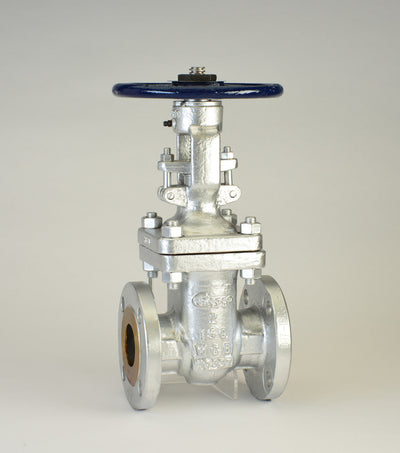
Gate valves suit infrequent, full-open isolation where you want minimal pressure drop, and they fail at everything else in tower service. They don't handle frequent operation or throttling in any water, and basin water adds a tower-specific failure: suspended solids settle into the seat pocket at the bottom of the body, and after a season the gate lands on packed silt instead of its seat. The valve you installed for emergency isolation then won't close during the emergency. Use gate valves on clean, treated closed loops if you like them. Keep them off open tower water.
 For such an application, consider a valve like the Jomar Valve T-351G. This gate valve has a lead-free cast bronze C89844 body with PTFE packing. It has a solid wedge gate with a rising stem and has a 300 CWP rating. Its dezincification-resistant bronze handles un-concentrated, potable city water without premature leaching or dezincification, and its rising stem design helps provide visual confirmation of whether it is open/closed while also keeping the stem threads out of the fluid path.
Pump Discharge: Check Valves Against Backflow and Water Hammer
A check valve at each condenser pump outlet closes automatically when the pump stops, which prevents reverse flow back through the idle pump and helps kill water hammer. On a single-pump loop, a plain swing check does the job.
Parallel pumps change the math. When one pump in a parallel set trips, the running pumps immediately drive flow backward through the dead one, and a swing check waits for that reversal before its disc slams shut. The slam is the hammer. A silent check, a type of spring-assisted center-guided design, closes before the flow reverses, so the trip is a non-event. Every parallel-pump tower header we review gets silent checks, and the dual-disc wafer style is our pick at 6 inches and above because it cuts both weight and face-to-face length against a flanged swing check.
Size the check to the pump's duty-point flow instead of the pipe diameter. An oversized check never fully opens, and in solids-laden tower water a fluttering half-open disc grinds its seat and hinge pin until it leaks. An undersized one chatters and robs head. Pull the actual GPM off the pump curve and size to that number.
 For parallel pumps, consider the Titan FCI CV 91-SS Series of wafer-type silent check valves. These check valves have spring-assisted center-guided closure, which eliminates water hammer issues when a parallel pump trips. They also have all 316 stainless steel construction, with excellent chloride pitting resistance and a compact wafer body and EPDM soft seat options.
 For a single pump rather than pumps in parallel, and let's say 2" or smaller in diameter, you might start out by looking at the Jomar Valve T-511G. It is a DZR cast bronze, Y-pattern swing check valve equipped with a metal-to-metal disc and a screw-in cap. It can be installed in vertical or horizontal positions, and its metal-to-metal seat provides a durable shutoff.
With these check valves, remember to not size this valve based solely on line size. Ensure your pump's design GPM produces enough flow velocity to achieve 100% full disc lift. An oversized check valve will flutter in open tower water, leading to pin and seat chatter.
Blowdown Control: The Valve That Protects the Whole System
Blowdown, or bleed, is the deliberate discharge of concentrated tower water so the dissolved solids never reach scaling levels. Conductivity-based automatic control is the recommended method: a controller reads tower-water conductivity as a proxy for TDS and opens the bleed valve whenever the reading exceeds setpoint. Get this one valve wrong and every heat exchanger downstream pays for it in scale.
The bleed valve cycles more than anything else in the loop and sees the dirtiest water in the plant, since it draws from the concentrated basin. Direct-acting solenoid valves fail here routinely; their small pilot orifices clog with the same grit the tower scrubbed out of the air. We recommend an electrically actuated full-port ball valve, 316 stainless or bronze body, driven by the conductivity controller for on/off duty, with a manual globe or needle valve downstream to set the bleed rate. The ball valve takes the cycling and passes the debris, and the globe valve lets you dial the flow once and leave it.

For the electrically actuated full port ball valve, consider the Bonomi MEN501 / VB Series Actuated Package. This butterfly valve has a ductile iron body with a CF8M stainless steel disc and a metal electric actuator. The valve has a lug style body and both seat and packing made from EPDM. It is also pressure rated to 250 CWP. The actuator is available in 12V/24V AC/DC and 100-240V AC and is rated NEMA 4.

For downstream throttling, take a look at the Chicago Valve Series 326 stainless globe valve. It has 316 cast stainless steel ASTM A351 CFM all-wetted construction. The packing and seal are both chemically resistant PTFE. In addition, it has a conical seat instead of a flat disc seat, which distributes flow velocity across the seating area and is rated up to 200 psi cold working pressure.
Sizing the Bleed Line
The arithmetic is short. Required blowdown equals evaporation divided by (cycles − 1), ignoring drift.
Practical Sizing Example (Cycles of Concentration vs. Bleed Rate):
Say your tower evaporates 30 GPM at design load (take the real figure from your own tower's thermal data, since it moves with load and weather).
At 3 cycles of concentration, you must bleed: Bleed = 30 ÷ 2 = 15 GPM
Raise the treatment program to 5 cycles and the bleed drops to: Bleed = 30 ÷ 4 = 7.5 GPM
That 7.5 GPM difference, running around the clock, saves more than 10,800 gallons a day of bleed (and equal makeup).
The bleed valve and its controller are usually the cheapest water-conservation hardware on the site. A full-port ball valve for on/off bleed is reasonable, but remember that a ball valve left cycling in scale-prone water can stick. A solenoid with a larger orifice or a motorized valve is the alternative
Sizing an actuated bleed valve and controller for your cycles target? Our engineers in Exton, PA will walk the numbers with you at 888-825-8800.
Makeup Water: Float Valves and Basin Level Control
The makeup float valve is the least expensive valve on the tower and the one most often set wrong. It needs adjustment so that no water wastes through the overflow when the pumps shut down and the basin surge rises, while still holding the operating level deep enough for positive pump suction at start-up. Set it high, and every pump stop sends paid-for, treated water down the overflow. Set it low, and the pumps pull air on Monday morning.
Bronze and brass bodies hold up fine on the makeup side, because city water ahead of the basin hasn't been concentrated or dosed yet. The selection problem there looks more like domestic water service, and the reasoning in our guide to the best potable water valves applies directly. Where the makeup ties to a potable supply, check your local code for backflow prevention requirements before you pipe anything.
Upgrade past the mechanical float when the installation justifies it. Multi-cell towers, sites that meter makeup for sewer-credit billing, and plants running freeze protection all benefit from a solenoid or actuated valve tied to a level sensor. If chilled water or hot water feeds the same building, our guides to the best valves for chilled water and the best valves for hot water carry the selection logic across those loops too.
Spec Your Tower Loop With a Real Engineer
Match every valve to the point it sits in and the chemistry it sees, and the loop runs for years without drama. When you want a second set of eyes on the trim, the check sizing, or the bleed controller, call ValveMan at 888-825-8800 or reach the team through our contact page. Real engineers, not a call center, backed by 60+ years in valves.