

Chilled water is easy duty on paper. Most loops run at or below roughly 150–200 psig, so Class 125/150 (or PN16) valves cover the service. Check static head plus pump shutoff head in tall buildings. The money questions sit elsewhere: how tight the shutoff is, how precisely the coil valve modulates, and how much pump head the valve package eats for the next twenty years.
⚙️ Key Takeaways
- Chilled water is low-pressure duty, so cost and performance trade-offs matter more than ratings.
- Match each valve type to its job, and choose in this order: type, then size, then materials.
- Don't throttle with isolation valves, and size control valves with Cv and authority.
- Spring-assisted checks prevent slam, at the cost of some pump head.
Three Jobs, Four Valve Types: How Chilled Water Loops Use Valves
Walk a typical plant from the chiller outward and the placement pattern writes itself. Resilient-seat butterfly valves isolate the chiller and the air handlers on the large mains. Full-port ball valves isolate coil branches and fan coils at 2" and under. A modulating control valve sits at each coil outlet and does the actual temperature control. A spring-assisted check valve rides the discharge of every pump so a tripped pump can't backspin on reverse flow.
Four valve types cover the whole loop. Gate valves sit this one out for most chilled water work because a typically multi-turn, often rising stem, is slow to operate, awkward to automate with quarter-turn actuators, and offers nothing a resilient-seat butterfly can't do in less face-to-face length. If you want the broader taxonomy before diving into chilled water specifics, our rundown of types of water valves covers the full family.
The decision order matters. Pick the valve type for the duty and the location first. Size it second. Choose materials last. Buyers who start from a price-per-valve spreadsheet end up throttling with ball valves and slamming swing checks at 2 a.m.
🔧 Tech Tip
Pick the valve type for the duty and location first. Size it second. Choose materials last.
Chilled Water Butterfly Valves for Mains and Equipment Isolation
At 2-1/2" and up, chilled water butterfly valves win on cost per inch of diameter and on face-to-face length. Chiller inlet and outlet, AHU isolation, and header sectionalizing are their natural homes. A resilient-seat design with an EPDM liner, built to MSS SP-67, handles chilled water and glycol solutions without drama, and EPDM is the correct seat for this service.
Body pattern deserves more thought than it usually gets. A wafer body clamps between flanges and costs less. A lug body threads onto studs from both flange faces, which permits dead-end service provided the valve has independent bolting on each side and you confirm the manufacturer's dead-end pressure rating, which is often lower than the full rating.

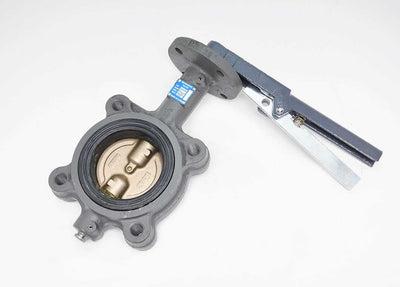
One of the valves we carry is the Milwaukee Valve CL223E lug style butterfly valve. It is made from ASTM A126 CL B cast iron valve with an aluminum/bronze (ASTM B148) disk and an EPDM liner. There are available in 2", 2-1/2", 3", 4", 5", 6", and 8" sizes. They offer bi-directional dead end service to 200 psi max and are field reparable. This type of valve is also available with a gear operator with sizes up to 12".
Our recommendation after 60+ years of watching plants get serviced is plain. Spend the extra money on lug-pattern valves at every chiller and AHU connection, and save wafer bodies for mid-run sectionalizing where both sides stay piped.
One detail almost nobody specifies on cold pipe is the extended neck. Chilled water lines get wrapped in insulation, and a standard-neck butterfly buries its stem and handle inside the jacket. An extended-neck design lifts the handle or actuator clear of the insulation, lets the lagging seal around the neck, and keeps a sweating valve body from soaking the jacket from the inside.
Be honest about the flow coefficient, too. A 2" wafer butterfly runs a Kv around 100, where a same-size full-port ball valve runs 300–400 (multiply Kv by about 1.16 for Cv). On an 8" main that concession is irrelevant. On a 2" branch it is real pump head, which is exactly why the next section exists.
Not sure whether lug or wafer fits your layout? Call a ValveMan engineer at 888-825-8800 — real engineers, not a call center.
Chilled Water Ball Valves for Branch and Coil Isolation

From 1/2" through 2", the full-port ball valve is the default isolation valve, and it earns the job. The bore matches the pipe, so the open-position pressure drop is close to zero. PTFE seats give bubble-tight shutoff that an elastomer-lined butterfly can't match over thousands of cycles. A quarter turn closes it. MSS SP-110 governs the construction. For the mechanics of trim, port styles, and ratings, our ball valve guide goes deeper than this article has room for.
Run the flow coefficient comparison again at branch scale. A coil branch already carries a strainer, a balancing device, a control valve, and a dozen fittings. Choosing an isolation valve with a full-port ball valve instead of a lower-flow-coefficient butterfly at the same size keeps the branch from quietly adding head the pump must supply every hour the plant runs.
Bronze bodies suit threaded copper branch piping, which is most fan coil work. Specify 316 stainless where the valve lives outdoors, where condensation is persistent, or where glycol concentration and inspection access argue for a body that shrugs off surface corrosion. On insulated lines, order stem extensions for the same reason the butterfly got an extended neck: the handle sits proud of the jacket and the packing stays reachable without tearing out insulation.
 The Apollo 77-0108-01 is an excellent option. It is a bronze full port 2-piece ball valve. It includes reinforced seats, an actuator mounting pad, and a blow-out-proof stem design. It is also available with a 316 SS ball (The 70-140 variant) and steam, as well as a locked retainer.
Another good option is the Bonomi 171N 2-way brass body valve. This full port valve has a chrome-plated brass ball within a brass body and steam and PTFE seats. They are pressure rated 600 WOG-150 WSP, but note that they are not to be used for drinking water.
Now the hard part. A standard ball valve is an isolation valve, and it should spend its life fully open or fully closed. Held near closed, the exposed edge of the seat sees high-velocity flow that wire-draws the PTFE, and shutoff degrades fast afterward. We've written a full answer to whether ball valves can be used for flow control, and the short version is that modulating duty belongs to the next section.
Chilled Water Control Valves: 2-Way vs 3-Way and the Sizing Math
Chilled water control valves do the real work of the system, and they are the valves most often bought wrong.
2-Way, 3-Way, or PICV
A 2-way valve throttles flow through the coil, which suits variable-flow systems: as valves close across the building, VFD-driven pumps slow down and you bank the energy savings. A 3-way valve mixes or diverts to hold total loop flow constant, which older constant-flow plants and some chiller minimum-flow requirements demand. New variable-flow designs should use 2-way valves almost everywhere, with a handful of 3-way valves at the far ends of long runs to maintain minimum circulation.

One example of a good 2-way valve would be some options from the Bonomi line. The Bonomi M8E710190V36 is a full port, V-port ball valve. Its body and ball are manufactured from CF8M stainless steel, and it has a 304 stainless steel stem and PTFE seats. It's rated for 1,000 psi and comes with a positioner.
A pressure-independent control valve (PICV) adds a built-in differential pressure regulator, so the valve holds its design flow as pump pressure shifts around it. On retrofits where the loop's pressure profile is poorly documented, a PICV is our recommendation because it reduces the need for a detailed hydraulic survey, provided the minimum differential pressure is available at the valve.
The Worked Example: Cv First, Then Authority
Cv has an exact definition: the gallons per minute of 60°F water that passes a fully open valve at a 1 psi pressure drop. Everything in sizing flows from that.
Practical Sizing Example (CV Calculation):
For a 20-ton coil at a 10°F ΔT, determine the required flow rate:Flow (GPM) = (24 × 20 tons) / 10°F = 48 GPM
Assuming a target 4 psi pressure drop across the fully open valve, calculate the required $C_v$:Cv = Q / √ΔP = 48 / √4 = 48 / 2 = 24
Select the valve whose rated Cv sits closest above 24 to ensure full capacity without over-sizing.
Check authority before you buy. Authority is the valve's full-open drop divided by the drop across the valve plus the coil circuit it controls (coil and its piping), and the target is 0.3–0.5. Below about 0.25, the valve loses resolution near closed and hunts; above 0.5 you gain control precision but spend more pump energy.
Practical Sizing Example (Valve Authority Check):
Verify valve authority (Target = 0.3–0.5) before purchasing to ensure stable control:Authority = ΔPvalve / (ΔPvalve + ΔPcircuit)
For a 4 psi valve drop and a 5 psi coil circuit drop:Authority = 4 / (4 + 5) = 4 / 9 ≈ 0.44
0.44 lands in target range. If the coil drop were 15 psi, authority would drop to 0.21 (causing hunting near closed position) and require resizing the valve for a larger share of the branch pressure drop.
Glycol shifts the math slightly. Glycol carries less heat per gallon than water, so the same load and delta-T needs more flow, roughly 10–15% more for 50% ethylene glycol. The full formula is Cv = Q × √(SG/ΔP), and 50% ethylene glycol at 40°F has a specific gravity of about 1.088. The specific gravity alone raises Cv about 4% (48 GPM at 4 psi gives ≈ 25); the added flow raises it further. On a valve already sitting at the edge of a size break, that tips the selection. Viscosity effects also apply at low temperatures.
Two final rules for coil duty. Specify an equal-percentage characteristic, because its flow curve offsets the coil's nonlinear heat transfer and yields near-linear capacity control. And expect the correct control valve to run one or two sizes smaller than line size; a line-size control valve is almost always oversized, spends its life barely cracked open, and controls poorly there. For driving these valves, our guide to control valve actuators covers electric versus pneumatic selection in detail.
Run your coil numbers past us before you commit to a size — call 888-825-8800 or send the specs to our team and get a sanity check from a real engineer in Exton, PA.
Chilled Water Check Valves: Stopping Backflow Without the Slam
The slam mechanism is simple once you picture the disc. A swing check closes by gravity and decaying forward flow, so when a pump trips, the disc is still mid-travel as the column reverses. Reverse velocity drives it shut, the moving water stops in an instant, and the pressure spike is water hammer, which the pipe hangers and the night-shift operator both notice.
A spring-assisted check closes before reverse flow develops, because the spring starts the disc home while forward flow is still decaying rather than waiting for backflow to do it. On chilled water mains, the dual-plate wafer check built to API 594 is the practical economical choice: short face-to-face, light enough to handle without rigging, and spring-closed by design. For the best slam protection, an axial-flow (nozzle-style) silent check closes fastest. Say it plainly, since it changes the pump curve: a spring-loaded check carries more open-position pressure drop than a wide-open swing check, and our piece on how check valves affect water pressure walks through that math. On a parallel-pump header, where one running pump will happily drive flow backward through an idle one, the slam protection is worth the drop every time.
Placement follows service logic. Put the check on the discharge side of each pump, between the pump and its discharge isolation valve..
Spec It Right the First Time
A chilled water loop lives or dies on the valves you can't see from the mechanical room. Get the shutoff, the coil modulation, and the check selection right, and the pump works less for the next twenty years.
Bring us your coil tonnage, delta-T, line sizes, and pump layout. Call 888-825-8800 or reach our team — real engineers in Exton, PA who've specified chilled water valves since 1965, not a call center reading from a script.