

A temperature regulator is the simplest temperature control loop you can buy. The sensor, actuator, and valve arrive as a single assembly, and the process itself provides the power. No controller. No instrument air. No wiring. We've been sizing these valves since 1965, and the same two mistakes still cross our desk every week: buyers size the valve to the pipe, and they pick a temperature range that buries their set point at the bottom of it. This guide fixes both.
⚙️ Key Takeaways
- Self-operated temperature regulators control temperature without external power
- Size the regulator by heat load and required Cv, not the pipe diameter
- Choose a temperature range that places the set point in its upper third
- Use self-operated regulators for stable loads and PID-controlled valves for fast or variable loads
What a Temperature Regulator Is (and What It Isn't)
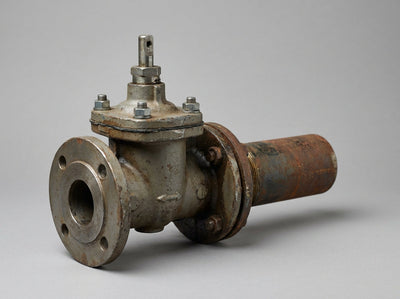
Temperature control valves fall into two categories: self-actuated regulators that need no external power, and externally actuated valves driven by a PID controller through a pneumatic or electric actuator. This article covers the first kind. A self-operated temperature regulator combines a sensing bulb, a capillary tube, a thermal actuator (diaphragm or bellows), and a valve body into one device. The heat of the process does all the work.
That independence is the whole value proposition. Self-acting temperature controls suit dirty and hazardous areas as well as locations remote from any power source. No air compressor can fail, no transmitter needs calibration, and no loop needs tuning. The installed cost is low, and a maintenance tech can rebuild one with hand tools.
You will find regulators holding temperature on steam-heated tanks and coils, heat exchangers, plating tanks, jacketed vessels, steam tracing, engine jacket water, and wash-down stations. Steam heating is far and away the most common service, which is why regulator selection usually starts alongside the rest of the steam valve specification.
A regulator is not a precision instrument for processes that change constantly. We will draw that line with real numbers in the decision framework below.
How the Thermal System Works: Bulb, Capillary, and Fill

The Working Principle
The sensing bulb contains a volatile fill. As process temperature rises, the fill vaporizes, and that vapor pressure travels up the capillary tube to press against a diaphragm. The diaphragm strokes the valve plug to close the valve in a direct-acting design, or open it in a reverse-acting design. When the process cools, vapor condenses back into the bulb, pressure falls, and a spring returns the plug. The loop runs continuously with zero outside energy.
Fill Types and What Accuracy to Expect
Vapor-pressure fills are the workhorse. A vapor-pressure regulator with an ethyl chloride fill can hold an 80–140°F process to within 1°F of set point, and model series across the fill family cover roughly -40°F to 450°F. That ±1°F figure matters, because several pages ranking for this topic flatly call regulators inaccurate. The truth depends on the fill and the load, not the category.
Wax-element (fusion-type) actuators are the other common design. They use a paraffin phase change (technology dating to the early 1900s) with a typical active band around 10°F. That band is too wide for tight process control, but it is exactly right for wash-down stations, freeze protection, and scald protection, where "close enough, forever, with no maintenance" wins.
Liquid-expansion fills round out the family. They respond to bulk fluid expansion rather than vaporization, and manufacturers offer them where the service profile favors that behavior. Our opinion after 60+ years: for steam and hot-water process heating, start with a vapor-pressure fill and move off it only for a documented reason.
Not sure which fill fits your service? Talk to a ValveMan engineer (real engineers, not a call center) at 888-825-8800. Tell us your medium and temperature band, and we'll point you at the right fill.
The Set Point Placement Rule Nobody Publishes
Here is the selection rule that lives in manufacturer service manuals but seldom in blog content. Choose a temperature range that puts your desired control point in the upper third of the range. Vapor pressure changes most per degree near the top of the range, so that is where the regulator is most sensitive and holds set point tightest. A regulator controlling 130°F should be bought with something like an 80–140°F range, not a 130–190°F range.
Overrange protection covers the other direction. Typical designs tolerate heating the bulb about 100°F above the controlled temperature without damage, so a process upset will not destroy the thermal system.
Direct-Acting vs Reverse-Acting, 2-Way vs 3-Way
Direct-acting regulators close as temperature rises. That's the configuration for heating service (steam, hot water, or hot oil feeding a coil or exchanger) because rising process temperature should throttle the heat source. Reverse-acting regulators open as temperature rises. This suits cooling service such as engine jacket water or quench flows, where rising temperature should admit more coolant.
Think about fill loss before you order. The vapor pressure of the fill strokes the valve, so if the thermal system ever leaks, the spring drives the plug back to its unpressurized position. On a typical direct-acting heating regulator, that position is open, which means uncontrolled heat input to the process. Confirm the fail position on the manufacturer's datasheet for your specific model, and decide whether the process needs an independent high-temperature cutout. Our recommendation is blunt: on any heating service where overtemperature can damage product or injure people, add a separate safety shutoff rather than trusting the regulator to fail gracefully.
 Body style is the next fork. Two-way bodies throttle a single flow path and cover most steam and water heating jobs. Three-way bodies either mix two inlet streams to one outlet or divert one inlet between two outlets; they fit closed-loop cooling and tempering applications where flow must be redirected rather than throttled.
Pressure-temperature ratings depend on body material, end connection, flange class, size, and temperature. For example, Watson McDaniel W91/W94 configurations include both 125# and 250# flanged options in larger sizes; verify the exact published pressure-temperature rating rather than assuming a size-only rule.
The rating drops as the body grows, which is a detail that catches people who upsize. For spec-driven jobs, verify the body's ASME B16.34 pressure class against the line spec, and ask about NACE-compliant trim if the service involves wet H₂S oil-and-gas service. And always verify the manufacturer’s pressure-temperature rating and the applicable piping/valve design standard, flange class, and end-connection rating for the specified assembly.
Spec-driven job with a line class and a NACE call-out? Send us the spec. A ValveMan engineer will match body class, trim, and fail position to your service — call 888-825-8800 or reach us through our contact page.
How to Size a Temperature Regulator: A Worked Example

The procedure has five steps, and it starts with the load, never with the pipe size.
1. Establish the heat load in BTU/hr.
Suppose we need to heat 1,500 gallons of water from 60°F to 160°F in two hours. That water weighs 1,500 × 8.34 = 12,510 lb. The heat required is 12,510 lb × 100°F × 1 BTU/lb·°F = 1,251,000 BTU, which over two hours is roughly 625,500 BTU/hr.
2. Convert the heat load to steam load.
With 50 psig steam supplying the coil, the latent heat from standard steam tables is about 912 BTU/lb. The steam load is 626,000 ÷ 912 ≈ 690 lb/hr. This gives us the flow rate we need.
3. Set the allowable pressure drop.
We assume that 50 psig steam enters the valve. We typically allow a drop of roughly 25–30% of the absolute inlet pressure on steam service, which keeps the valve doing real work without approaching critical flow. Here we take ΔP = 20 psi, so P1 = 64.7 psia and P2 = 44.7 psia.
4. Calculate the required Cv.
Using the standard steam formula Cv = W ÷ (2.1 × √(ΔP × (P1 + P2))). W is our flow rate in lb/hr and the pressures need to be in psia. We get Cv = 690 ÷ (2.1 × √(20 × 109.4)) = 690 ÷ 98.2 ≈ 7.0. Note that that is for saturated steam with non-choked flow.
If Cv math is new territory, send us your heat load, supply pressure, and media. A ValveMan engineer will run the numbers with you — 888-825-8800.
5. Select the smallest body that meets the Cv.
Consult the manufacturer's Cv table (like this spec sheet for the Watson McDaniel temperature regulators) and pick the smallest body at or just above 7. That commonly lands at a 3/4" or 1" valve — even if the steam main is 2". This is our estimate of the Cv. We recommend using the selected manufacturer’s steam-sizing procedure for final selection, especially where steam is superheated, pressure drop is high, or a specific valve recovery factor applies.
Here's where a problem can come in: an oversized temperature control valve operates in only the first 10–20% of its travel, where tiny stem movements cause big flow changes. The result is hunting: overshoot, slam toward closed, undershoot, repeat. It also chews up the seat. Size to the load, not the pipe, and use pipe reducers without apology.
And before you order, cross-check three more items: the body pressure rating against your supply, the end connections (NPT versus flanged) against your piping, and the body and trim materials against the media.
Choosing the Bulb, Capillary, and Thermowell
The bulb is the sensor, so match it to the medium. A plain bulb belongs fully immersed in liquid service. For air or duct temperature control, specify a finned bulb because the fins increase effective surface area, which compensates for air's poor heat-transfer coefficient and gives the bulb an adequate response time that a plain bulb in still air cannot deliver.

A thermowell is worth its small cost on almost any pressurized liquid system. It contains the pressure boundary and lets you pull the bulb for replacement without draining the vessel. The tradeoff is a slower response, since heat must pass through the well wall before the fill sees it. Keep that in mind on processes that move quickly.
Capillary length has hard limits that rarely appear in one place. Standard capillary lengths run up to about 24 feet, with non-standard lengths available to 52 feet. Route the capillary away from heat sources, avoid kinks, and protect it from crushing. A pinched capillary is a dead regulator. For corrosive service such as plating tanks and chemical baths, Teflon- or Kynar-coated bulbs are available and are the right call.
Regulator or Pneumatic Control Valve? A Decision Framework
The core rule comes straight from manufacturer application guidance. Self-operated regulators suit relatively stable loads, where small stroke changes correct gradual drift. Sudden or large load swings call for a pneumatically actuated control valve with a PID controller, which can reposition fast and tune to the process.
| Criterion | Self-Operated Regulator | Pneumatic Control Valve + PID |
|---|---|---|
| Load swing behavior | Stable, gradual drift | Sudden or large swings |
| Set point changes | Rare | Frequent |
| Achievable accuracy | About ±1°F with a well-matched vapor-pressure fill on a stable load | Tight across a wide range, tunable |
| Utilities required | None | Instrument air and power |
| Dirty, hazardous, or remote sites | Excellent fit | Requires supporting infrastructure |
| Installed cost | Low | Higher |
This table also settles the accuracy argument you will see across the internet. Blanket claims that regulators are "far less accurate" only hold when the fill is mismatched to the range or the load swings faster than the thermal system can follow. Put the control point in the upper third of a vapor-pressure range on a steady load, and ±1°F is a realistic expectation.
Here's our opinionated take: start with the regulator whenever the load qualifies. It is cheaper to install, simpler to maintain, and it keeps working when the air compressor does not. Reserve actuated control valves for the processes that genuinely demand them, and treat the powered valve as the upgrade path when process complexity grows.
Installation and Maintenance That Keeps It on Set Point
Two piping rules are non-negotiable. First, install a properly sized strainer upstream (dirt on the seat a major cause of drift and seat leakage), and a Y-strainer is cheap insurance. Second, pipe a bypass line with shut-off valves around the regulator so it can be serviced without shutting down the process.
Immerse the bulb fully per the manufacturer's minimum, mount it where it sees representative flow rather than a stagnant corner, and route the capillary away from hot surfaces. On steam service, include the standard accessories: a trap to drain condensate from the coil and a check valve where backflow is possible.
When performance slips, the symptoms point to the cause.
| Symptom | Most Likely Cause |
|---|---|
| Hunting or cycling around set point | Oversized valve working in the first 10–20% of travel |
| Never reaches set point | Undersized valve, low supply pressure, or lost thermal fill |
| Slow response | Fouled bulb or thermowell, or poor circulation at the bulb |
| Seat leakage or temperature creep | Debris on the seat or worn trim — check the strainer first |
FAQ
What is a temperature regulator and how does it work? A temperature regulator is a self-operated control valve. A sensing bulb filled with a volatile liquid sits in the process; as temperature rises, the fill vaporizes, and pressure travels up a capillary tube to a diaphragm that strokes the valve plug. No electricity or air supply is needed, because the process itself powers the valve.
What is the difference between direct-acting and reverse-acting regulators? A direct-acting regulator closes as temperature rises, which makes it the standard choice for heating with steam or hot water. A reverse-acting regulator opens as temperature rises, which suits cooling service such as engine jacket water. Pick the action based on the service and on the safe fail position if the thermal fill is ever lost.
How accurate is a self-operated temperature regulator? Accuracy depends on the fill type, the range selection, and load stability. A well-matched vapor-pressure fill can hold within about 1°F of set point on a stable load, especially with the control point in the upper third of the selected range. Expect wider deviation on fast-swinging loads , which is the signal to consider a powered control valve.
What happens if a temperature regulator is oversized? An oversized valve does all its work in the first 10–20% of travel, where small stem movements cause large flow changes. The result is hunting and accelerated seat wear. Sizing to the actual load prevents both problems.
Do self-operated regulators need electricity or air? They need neither, which is exactly why they excel in dirty areas, hazardous locations, and sites remote from any power source.
Get the Sizing Right the First Time
ValveMan has been helping engineers size and select temperature regulators since 1965. You get real engineers — not a call center — working from our shop in Exton, PA. Send us your heat load, supply pressure, and media, and we will run the numbers with you.
Call 888-825-8800 (Mon–Fri 8:00 AM–6:00 PM) or reach us through our contact page for application help.