

We’ve all been there —staring at a valve, almost certain you know whether it’s open or closed, but not quite confident enough to act. Maybe it’s a valve type you’ve never used before, like a butterfly valve, or one with no clear handle position, like a non-rising gate or globe valve. The good news? Most valves have simple visual or mechanical cues that make it easy to tell.
In this blog post, we’ll show you how to identify the on and off positions for the following valve types:
By the end, you’ll know exactly how to confirm a valve’s position without turning anything you shouldn’t!
How to Tell if a Ball Valve is Off or On
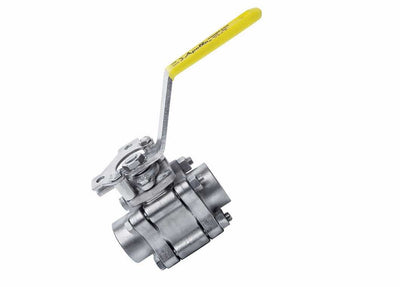
Ball valve open and closed positions are easy to identify. When the handle is parallel to the pipe, the valve is open, and water can flow through. When the handle is perpendicular to the pipe, the valve is closed, and flow is blocked. This applies to most standard ball valve designs.
Standard ball valves have a T-looking handle that should point in the direction of flow when the valve is open. This gives a good visual indication as to which side of the valve still contains water after the valve is shut off.
 A ball valve in the off position
How to tell if a Gate Valve or Globe Valve is On or Off
Any valve with a handwheel is a bit trickier than a ball valve. First, there is no intuitive indication that the valve is on or off. Second, it is hard to tell if the valve is completely off or on. With these valves, you have to turn them to tell. This means you better know the right direction to turn them otherwise you might make a big mess.
To turn a gate valve off, turn the handwheel clockwise. If you don't spend a lot of time staring at old, analog clocks, you may not think in terms of "clockwise" or "counter-clockwise." Remember that you need to turn the valve to the right. More specifically, turn the handwheel so that the top of the handle moves toward the right. This works regardless of the direction you face the handwheel. To turn a gate valve on, turn the handwheel counter-clockwise, meaning that the top of the handwheel moves toward the left. Once the valve is all the way on or off, the handwheel will no longer turn.
As a final note, a few rare handwheel-operated valves do turn in the opposite direction—clockwise to open and counter-clockwise to close—but these are quite rare. However, it is always good practice to check the handle to see if it shows the correct direction to turn.
 A valve with a handwheel. Note that the direction to "shut" the valve is indicated.
Now, most gate valves and globe valves have a rising stem. This means that the threaded valve stem moves outward/upward from the valve body as you open it, giving you a clear visual indicator that the valve is open. When turned off, the stem retracts back flush with the bonnet. It then retracts back down when the valve is turned off. A common household example of a rising-stem design is a outdoor globe-style hose spigot. You can look at the stem and try to visually gauge if the valve is on or off. However, this can be quite unreliable, and confirming it by hand is a good idea if you need to be sure the valve is on or off.
Some valves with handwheels have non-rising stems. This means that there is no way to tell visually if the valve is on or off, and manual confirmation is required. In any case, it is best practice to manually confirm the valve is correctly positioned.
How to Tell if a Butterfly Valve is On or Off
Butterfly valves are intuitive and operate like ball valves, in terms of opening and closing. Butterfly valves are widely used in commercial and industrial piping system designs due to their compact footprint and simple quarter-turn operation. The butterfly valve is off when the handle is perpendicular to the pipe. The valve is on when the handle is parallel to the pipe.

Butterfly valves in the on position.
Butterfly valve handles are a bit different than ball valves because they have a latching mechanism. This allows the handle to be positioned somewhere between off and on to regulate flow. Ball valves are generally only used in either the on or off position. The latch on a butterfly valve handle prevents the flow from pushing the valve into the full-open position. As is the case with ball valves, the handle should point in the direction of flow through the pipe.
How to Tell if an Actuated Valve is On or Off
Valves like butterfly valves may not have manual handles. Instead, they have actuators, meaning that an electric or pneumatic force controls the on/off position of the valves. Even without a manual lever, most quarter-turn actuators feature a visual beacon indicator (a raised dome or pointer on top of the actuator casing) that clearly displays "OPEN" or "CLOSED." Additionally, many automated valves feature limit switches wired back to a control system or local status LEDs to report exact valve position. Actuated valves are connected to control systems that indicate if the pipes are on or off. The best way to tell if an actuated valve is properly functioning is to install flow meters downstream.

Here is an actuated butterfly valve. This one also has a manual handwheel.
Quite a few actuated valves also have a manual handle as a back-up for emergencies, but these are not adjusted in usual operation. These manual overrides also include built-in position scales or indicators so operators can confirm valve status during power loss or maintenance.
Check Valves, Pressure Regulators, and Relief Valves
Sometimes you may come across a valve that looks like its handle broke off, or at least that's what some of these valves look like to me. These are probably either a check valve, a pressure reducing valve or a pressure relief valve. These valves are never really "off." Check valves prevent fluid from flowing the wrong direction in a pipe. Thus, they are always "off" to one direction, and always "on" for the other. The only concern with these valves is to ensure they are installed in the right direction. You can confirm this by finding the arrow on the check valve and ensuring that it points in the direction you want the fluid to be able to flow.
Pressure reducing valves, which are the valves right after your water meter, reduce the pressure (shockingly). They are, essentially, a partly open valve and often have a nut at the top of the valve where a handle might go. This nut can be turned to adjust how much pressure is reduced across the valve.
 A pressure reducing valve. © Raimond Spekking / CC BY-SA 4.0
A pressure relief valve is always off until the pressure in the system reaches a certain threshold. Then, the valve opens. These are safety devices, and the most common example is the safety relief valve on a water heater. These automatic valves—check valves, pressure regulators, and pressure relief valves—do not feature traditional manual handles. Instead, their state is determined automatically by system pressure and flow direction, though safety relief valves feature test levers for manual inspection.
Conclusion
Hopefully now you have a handle on how to tell if a valve is on or off. Ball valves and butterfly valves have handles that go with the flow. And gate valves and globe valves turn right until they're water-tight. Here at ValveMan, we have lots of great products and expert information. We cover topics a lot more advanced than this one, and we have a broad range of products for every use. We encourage you to look around on our site and see what you like!
Here are a few recommended articles: