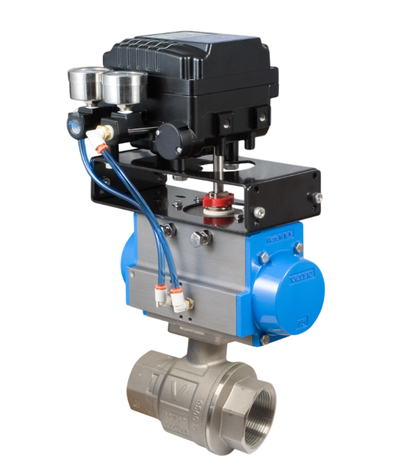


When it comes to a critical service valve, you want the best valve actuator you can buy. For decades, rack & pinion designs have dominated the field. However, recently, vane actuation has begun to take a significant portion of the marketplace. This is due in part to its versatility and compact design.
Regardless, the question remains, "Which is the better design, and the greatest ROI?" The answer to that question requires considering more than a name brand, quality, or price--it requires a complete understanding of design differences and what that means in the long run. Once this difference is established, then you can decide which design will best fit your application.
How Vane Actuation and Rack and Pinion Actuators Work
- Rack & Pinion: A rack & pinion actuator is made up of three major parts. There are two opposing pistons--each with its own set of gear teeth--known as racks. Both racks are set against a centered pinion gear. The racks move back and forth, causing the pinion to rotate clockwise and counter-clockwise.
-
Vane Actuator: Vane actuators do not rely on this linear-to-rotary conversion. Instead, there is only one moving part--the internal vane--that is powered by inlet air.
How to Compare Rack & Pinion and Vane Actuation
Both designs perform the same job, but in different ways. Linear-to-rotary conversion requires more working parts: "O" rings, seals, and springs. To its credit, the rack & pinion design is tried and true. Unlike vane actuation, the rack & pinion has been around for decades; however, because of it many parts, rack & pinion seem to provide more opportunities for failure and breakage. An actuator is no small investment; thus, you want an actuator that provides longevity and versatility.
Vane actuators are less complicated and have only one moving part. This means that a vane actuator's longevity may be measured by up to 4 times as many millions of operations. In addition, the action of a vane actuator can be set/reset easily from air-to-open and air-to-close by simply adjusting the solenoid valve. That in itself is very difficult (if not impossible) to do with a traditional rack & pinion. The rack & pinion would have to be completely disassembled and then re-assembled, which is simply no easy task.

Easytork Actuators
Now that you have some understanding how vane actuators and rack & pinion actuators work, you may be interested in trying out a vane actuator. If you're unsure of which manufacturer to try, the pros at ValveMan believe Easytork vane actuators win hands down. Easytork springless pneumatic actuators are high-performance, quarter-turn rotary systems featuring a patented aluminum vane body with an integral air reservoir. And they boast the longest life cycle at the lowest lifetime cost.
Easytork vane actuators (EVAs) are also the most compact on the market today, and will mount to almost any valve. The vane seal is pre-lubricated with grease in the plant, eliminating re-lubrication (under normal operating conditions). Standard operating temperature runs between -4°F to 176°F.
Easytork actuators operate in the double acting principal for either double-acting or fail-safe functions. This eliminates corrosion from external environments, as there is zero vacuum effect to pull it in. And while clean, dry air is the anticipated supply media, other inert gases such as natural gas, nitrogen, and argon may be used. In addition, thinned hydraulic oil may also be used.
Conclusion
Easytork easily leads the competition when it comes to vane actuation. Rugged, reliable, and state-of-the-art, EVAs are the next generation of fail-safe actuators and truly worth the investment. For more information, contact the experts at Valveman.
If you have enjoyed this article from our valve store and would like to read another, you might try: